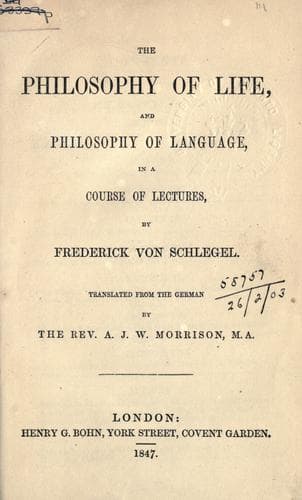
The philosophy of life, and philosophy of language, in a course of lecturesSchlegel, Friedrich von
Philosophy
The philosophy of life, and philosophy of language, in a course of lectures
Schlegel, Friedrich von
Language and languages -- Philosophy; Life; Philosophy
can not have been the original constitution of man’s mind to be thus a
prey to manifold dissension, and split, as it were, into pieces and
quartered. This discord is, undoubtedly, in the true meaning of the
word, a fact, the only one which every individual can without hesitation
vouch for on the immediate and independent testimony of his own
experience. For the cause of this well-authenticated fact we have only
to look to that event which revelation has made known, of which each man
must perceive the sad traces within his own heart. It began with that
eclipse of the soul which preceded and commenced the present state of
man, and was occasioned by the intervention of a foreign body between it
and the sun which gave it light. But if the soul, the thinking as well
as the loving soul, be the center of consciousness, then, in this great
and general darkening of the center, the entire sphere, in its whole
essence and structure, must have been altered. And, consequently, in its
philosophical aspect, and apart from all special moral depravity in the
independent actions, evil habits and passions of individuals, the soul
is no longer what it was originally, as created and designed by the
Almighty.
Thus, then, the whole human consciousness is filled with unmitigated
discord and division, not merely in its mixed rational and sensuous or
terrestrial and spiritual nature, but thought itself is at issue with
life. And, moreover, while in the thought the internal and the external,
faith and science, are involved in a hostile contrariety, disturbing and
destroying each other, so is it also in life with the finite and the
infinite, the transitory and the imperishable. In such a state of
things, therefore, and from this point of view, the problem of
philosophy, as already remarked, can not well be any other than the
restoration of the consciousness to its primary and true unity, so far
as this is humanly possible. Now that this true and permanent unity, if
it be at all attainable, must be looked for in God, is at all events an
allowable hypothesis. For it will not be disputed, except by one who
holds both this unity itself and its restitution to be absolutely
impossible. But this is a point on which much may be advanced on both
sides, and which, therefore, since mere disputing can avail nothing
either one way or the other, can only be decided by the fact--the issue
of the attempt. On this hypothesis, then, even philosophy must in every
case take God for the basis of its speculations--set out from Him, and
draw in every instance from this divine source. But then, considered
from this point of view, and pursuing this route, it is no idle
speculation and simple contemplation of the inner existence and thought
alone--no dead science--but a vital effort and an effectual working of
the thought for the restoration of a corrupt and degraded consciousness
to its natural simplicity and original unity. And this is the way which
Public-domain text, read in full here on John Shaqi.
Reviews
Reviews
No reviews yet
Be the first to share your thoughts on this work.
Elsewhere in the archive
Join the Discussion
Join the discussion
Sign in to leave a comment or review.
Sign InorCreate an account