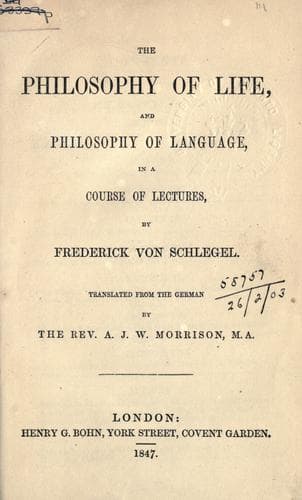
The philosophy of life, and philosophy of language, in a course of lecturesSchlegel, Friedrich von
Philosophy
The philosophy of life, and philosophy of language, in a course of lectures
Schlegel, Friedrich von
Language and languages -- Philosophy; Life; Philosophy
we have marked out for the course of our speculations, or, rather, the
end which we must strive, however imperfectly, yet at least to the best
of our abilities, to attain to. And, accordingly, each of the four
preceding Lectures, although in free sketchy outline, contains an
attempt to put an end to and reconcile some particular schism among
those which are the most marked and predominant in the consciousness,
and which in essential points must disturb the whole of life. How far in
these four introductory essays this problem has been satisfactorily or
completely solved and happily settled, is a question which will be best
and most fairly tested by the idea of philosophy, as having its true end
and aim in the restoration of this corrupt consciousness to its sound
state--to its original unity and full energy of life.
The discord between philosophy itself and life was the first that I
attempted to get rid of. But now, if in the place of abstract thought
and the dialectical reason, we are entitled to look to the thinking and
loving soul for the true center of man’s consciousness, then the
imaginary partition-wall between science and life at once crumbles away.
Our second Lecture was occupied with the discord which subsists between
the finite and the infinite--the eternal and the perishable; and,
because this involved a problem which can only be solved by life and
reality, I therefore confined myself to pointing out the way in which we
may hope to discover their unity and equation. With this view, I
attempted to establish a vivid conviction that there is a true
enthusiasm wherein the illimitable feeling manifests itself as actual,
and that even the earthly passion of love assumes, in the holy union of
fidelity and wedlock, the stamp of the indissoluble and eternal, and
becomes the source of many divine blessings, and of many moral ties,
which are stronger, and furnish a firmer moral basis to society, than
any general maxims, or than any ethical theory which is built upon such
notional abstractions, far more than upon the pregnant results of the
experience of life. And lastly, in pure longing, I pointed out an effort
of man’s consciousness directing itself to an infinite, eternal, and
divine object. But, as this longing can only evince its reality by the
fruits it brings forth, I reserved, to a future opportunity, the more
precise determination of this question. The theme of our third Lecture
was the existence and the reconciliation of that schism which, both in
thought and life, divides the internal and the external worlds. If all
knowing be a mere process of the reason, then must this discord between
the inner and the outer be forever irreconcilable, and we should be
utterly at a loss to conceive how a foreign and alien body could ever
have found entrance from without into our Me, and become an object of
its cognition. But if every species of knowing be positive--if, also,
the cognition of the spiritual and divine be nothing else than an
Public-domain text, read in full here on John Shaqi.
Reviews
Reviews
No reviews yet
Be the first to share your thoughts on this work.
Elsewhere in the archive
Join the Discussion
Join the discussion
Sign in to leave a comment or review.
Sign InorCreate an account