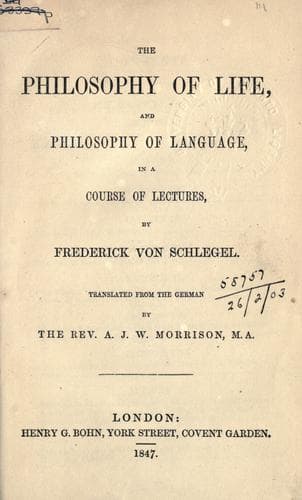
The philosophy of life, and philosophy of language, in a course of lecturesSchlegel, Friedrich von
Philosophy
The philosophy of life, and philosophy of language, in a course of lectures
Schlegel, Friedrich von
Language and languages -- Philosophy; Life; Philosophy
And now as regards understanding and will, as a division of powers
essential to the mind or spirit, which, however, as such, is not
necessarily inharmonious: the expression already touched upon of another
of our modern German philosophers, will serve as a transition to and
commencing point for my remarks. According to this memorable assertion
with regard to the mind [_geist_], and which will serve as an
appropriate pendent to that last quoted about the soul, the essence of
mind or spirit in general consists in the negation of the opposite.[26]
Now I can not stop at present to inquire what sense this would give, if
applied to the uncreated spirit, and the Creator of all other spiritual
beings. But as concerns created spirits: their essence, contrariwise,
consists principally in an eternal affirmation. But this, however, they
have not of and from themselves, but it is the affirmation of the one to
which God has exclusively destined them. But it is not of themselves,
but of God and His energy, of whom these created spirits are, as it
were, but a ray--a spark of His light--therefore, in this ray, not only
sight and understanding, but also thought and deed, will and execution,
are simultaneous and identical. And it is in this respect that they are
so totally different from men. Now this ray of light, imparted to them
from God, is nothing less than the thought of their destination--of the
purpose of their being--in a word, their mission, if we may speak after
a human fashion, and in the prevailing phraseology. And, indeed, in all
ancient languages, the pure created intelligences have these names from
that mission which constitutes their essence; for their essence is even
perfectly identical with this divine mission or inborn eternal
affirmation. To the fallen spirits, on the other hand, the maxim above
quoted applies truly enough: their essence consists, not in the divine
affirmation, or the mission which they have abandoned, but rather in the
eternal, though bootless, denial of their opposite, which is even
nothing less than the divine order. For to their ambitious intellect and
perverse wills, the latter, in all probability, appeared far too loving,
and, therefore, unintelligible; while, to their censorious judgment, it
seemed deficient in rigor of consequence, and not unconditional and
absolute enough.
Public-domain text, read in full here on John Shaqi.
Reviews
Reviews
No reviews yet
Be the first to share your thoughts on this work.
Elsewhere in the archive
Join the Discussion
Join the discussion
Sign in to leave a comment or review.
Sign InorCreate an account