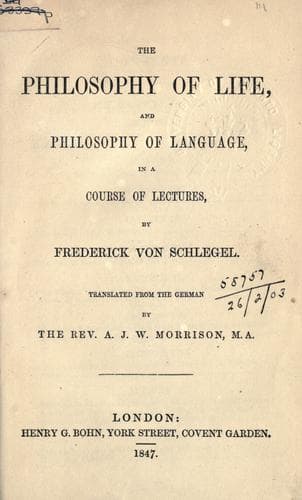
The philosophy of life, and philosophy of language, in a course of lecturesSchlegel, Friedrich von
Philosophy
The philosophy of life, and philosophy of language, in a course of lectures
Schlegel, Friedrich von
Language and languages -- Philosophy; Life; Philosophy
All that has hitherto been said reduces itself to the following result.
As by the first obscuration and eclipse of the human soul the very body
of man was deteriorated, and having been originally created with a
capacity of immortality, fell a prey to death, and received the germs,
or became liable to many diseases, as roots of death--which is not guilt
itself, but the natural result of guilt--so in his consciousness there
was then implanted, and has ever since been propagated, a germ of
intellectual death, and manifold seeds of error, which, however, are not
a new sin, but merely the natural consequences of the first sin and the
original corruption of the soul. In four different forms, according to
the four cardinal points and fundamental faculties of the human
consciousness, does this inborn error and fruitful germ of erroneous and
false thinking show and develop itself. We have already spoken of this
futile idea of the deadness of all external life, which has taken such
deep root in the center of all human thought--in the dead abstract
notion and the empty formula, and which, clinging as an original taint
to the human mind as at present constituted, renders it so difficult for
all those who, not content with merely observing nature, wish really to
understand it in its living operation, and, moreover, to imitate in
thought its dynamical law, and the inner pulse of its vital forces. For
in the abstract notion all this evaporates, and when confined within
such dead formularies, the true life of nature quickly becomes extinct.
This, therefore, is the primary source of error--the leading species of
barren and futile thinking in the abstract understanding. But now this
dead and lifeless cogitation of abstract ideas, with its processes of
combining and inferring, or of analyzing and drawing distinctions, may
be carried on into infinity, as being that wherein the essence or
function of reason consists, and also as giving rise to interminable
disputes and contradictions. Consequently this form of the reason, which
is ever pursuing dialectical disputations, or else skeptically
renouncing its own authority, even because it never allows itself to
proceed in what alone is its legitimate course, becomes thereby a second
source of error and false thinking among men. And, indeed, this
erroneous procedure of the dialectical reason, which is incessantly
working out or analyzing its abstract notions, is the effect of the
present constitution of the human mind; so that no individual can in
justice be blamed on its account, nor can its perverted conclusions and
corrupting results be fairly imputed to ulterior views and principles of
an immoral character.
Public-domain text, read in full here on John Shaqi.
Reviews
Reviews
No reviews yet
Be the first to share your thoughts on this work.
Elsewhere in the archive
Join the Discussion
Join the discussion
Sign in to leave a comment or review.
Sign InorCreate an account