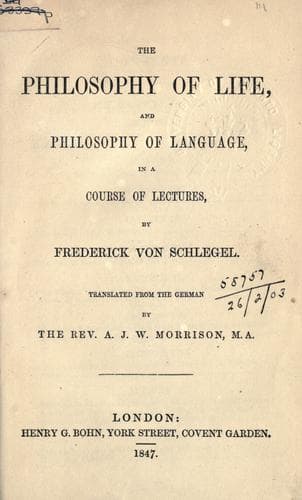
The philosophy of life, and philosophy of language, in a course of lecturesSchlegel, Friedrich von
Philosophy
The philosophy of life, and philosophy of language, in a course of lectures
Schlegel, Friedrich von
Language and languages -- Philosophy; Life; Philosophy
beneficial, by being advanced absolutely, and without qualification, are
converted into so many violent factions, which, distracting the minds of
men and inflaming their passions, produce a wide-spread and fearful
anarchy.
The dead abstract notions of the intellect, the dialectical disputes of
the reason, the purely subjective and one-sided apprehension of objects
by a deluded fancy, and the absolute will, are the four sources of human
error. Considered apart from the aberrations of passion, special faults
of character, and prejudices of education, as well as the false notions
and wrong judgments to which the latter give rise--these four are the
springs from which flows all the error of the soul which makes itself
the center of the terrestrial reality, and which, springing out of this
soil, is nourished and propagated by it. To what, then, are we to look
to dispel these manifold delusions but to a closer and more intimate
union of the soul with God as the source of life and truth?
What, let us therefore ask, is the organ by which such closer union with
and immediate cognition of God is to be effected? Plainly not the
understanding, even though as the cognitive sense of a revelation of
spirit, and of the spirit of revelation, it carries us through the first
steps toward a right understanding of ourselves and the Creator. For so
long as we confine ourselves to the understanding, which, at most, is
but a preparatory and auxiliary faculty, we shall only make an
approximation. It is only when the divine idea, passing beyond the
understanding--the mere surface, as it were, of our consciousness--penetrates
into the very center of our being, and strikes root there, that it is
possible, with a view to this end, to draw immediately from the primary
source of all life. Now, the organ which essentially co-operates in
this work is the will, which, in such co-operation however, divests
itself entirely of its absoluteness. On this account I called the will
the sense for God, or the sense which is appropriated to the perception
of Deity.
Public-domain text, read in full here on John Shaqi.
Reviews
Reviews
No reviews yet
Be the first to share your thoughts on this work.
Elsewhere in the archive
Join the Discussion
Join the discussion
Sign in to leave a comment or review.
Sign InorCreate an account