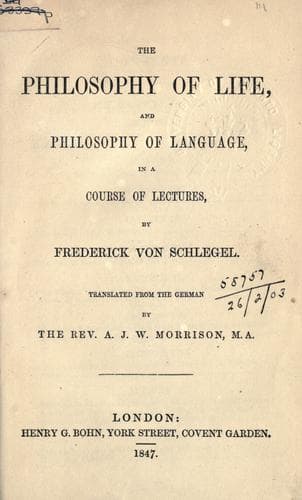
The philosophy of life, and philosophy of language, in a course of lecturesSchlegel, Friedrich von
Philosophy
The philosophy of life, and philosophy of language, in a course of lectures
Schlegel, Friedrich von
Language and languages -- Philosophy; Life; Philosophy
In considering the imagination as a source of error, we have no need to
select the instance of a fancy satanically inflamed to passion, or
satanically deluded, or even one of a purely materialistic bias and
leaning. For fancy, even in its greatest exaltation and purest form, is
at best but a subjective view and mode of cogitative apprehension, and,
consequently, as such, is ever a fruitful parent of delusion. How very
rarely an imagination is to be found which is not predominantly
subjective, is shown precisely in the very highest grade of its
development--in the creations of imitative art. Of the exalted geniuses
who in single ages and nations have distinguished themselves from the
great mass, and attained to that rare eminence--the reputation of the
true artist; out of this short list of great names, how few can be
selected of whose productions it can be truly said and boasted--Here in
this picture we have something more than a mere general view, or the
peculiar fantasy of an individual; here life and nature stand before us
in their full truth and objective reality, and speak to us in that
universal language, which is intelligible to men of all countries and
all times! And the same remark applies to the whole domain of scientific
thought in general; but especially to physical and historical science.
In like manner, in the sphere of the will, it is not merely immoral
volitions, which, as such, must ever be false and wrong, that are
exclusively the source of erroneous thought. The spring of those errors
which we are at present considering lies in the very form of the will
itself, _i.e._, in the absolute willing, even though its object and end
be, in themselves, perfectly legitimate and unexceptionable. That this
absolute willing--or, to speak more humanly, and in ordinary language,
self-will and obstinacy--is a fundamental and hereditary failing of the
human character, as at present constituted, which shows itself in the
very youngest children, with the first dawn of reason, and requires to
be most watchfully checked, is but too well known to every teacher and
every mother. But not in infancy only, but also in the most important
and comprehensive relations of life--nay, even in the history of the
world--this same absolute willing proves the most pernicious of all the
sources of error and corruption in the soul and life of man, even when
its object is not unmitigatedly bad, or when, perhaps, it may even
deserve to be called great and noble. It is through this absolute
willing that the sovereign with unlimited authority, even though he be
gifted with a strong and comprehensive intellect, and possessed of many
estimable qualities and moral virtues, becomes, nevertheless, the
oppressor of his people and the merciless tyrant. Through it, also, in
states which are not monarchical, but where the supreme authority is
divided among several estates, views and principles which, calmly
considered and duly limited by opposing principles, are true and
Public-domain text, read in full here on John Shaqi.
Reviews
Reviews
No reviews yet
Be the first to share your thoughts on this work.
Elsewhere in the archive
Join the Discussion
Join the discussion
Sign in to leave a comment or review.
Sign InorCreate an account