The Philosophy of the Moral FeelingsAbercrombie, John
Religion
The Philosophy of the Moral Feelings
Abercrombie, John
Ethics
Produced by Thierry Alberto, Janet Blenkinship and the
Online Distributed Proofreading Team at http://www.pgdp.net
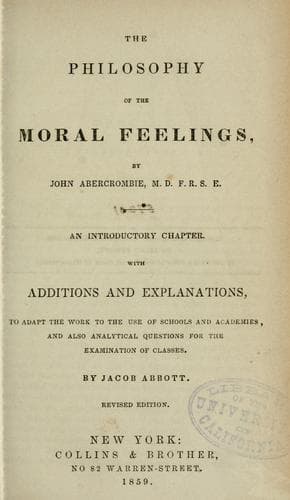
THE
PHILOSOPHY
OF THE
MORAL FEELINGS.
BY
JOHN ABERCROMBIE, M.D. OXON. & EDIN.
V. P. R. S. E.
FELLOW OF THE ROYAL COLLEGE OF PHYSICIANS OF EDINBURGH;
MEMBER OF THE ROYAL ACADEMY OF MEDICINE OF FRANCE;
AND FIRST PHYSICIAN TO HER MAJESTY IN SCOTLAND.
FIFTH EDITION.
LONDON:
JOHN MURRAY, ALBEMARLE STREET.
MDCCCXXXIX.
EDINBURGH:
Printed by Balfour and Jack, Niddry Street.
PREFACE.
In a former work, the Author endeavoured to delineate, in a simple and
popular form, the leading facts relating to the Intellectual Powers, and
to trace the principles which ought to guide us in the Investigation of
Truth. The volume which he now offers to the public attention, is
intended as a sequel to these Inquiries; and his object in it is to
investigate, in the same unpretending manner, the Moral Feelings of the
Human Mind, and the principles which ought to regulate our volitions and
our conduct as moral and responsible beings. The two branches of
investigation are, in many respects, closely connected; and, on this
account, it may often happen, that, in the present work, principles are
assumed as admitted or proved, which, in the former, were stated at
length, with the evidence by which they are supported.
In presenting a fifth edition of this volume, the Author feels most
deeply the favourable manner in which it has been received, and the
notice which has been bestowed upon it by those whose approbation he
regards as a distinction of the most gratifying kind. He had two objects
chiefly in view when he ventured upon this investigation. The one was to
divest his inquiry of all unprofitable speculation, and to shew that the
philosophy of the moral feelings bears directly upon a practical purpose
of the highest moment,--the mental and moral culture of every rational
being. The other was to shew the close and important relation which
exists between this science and the doctrines of revealed religion, and
the powerful evidence which is derived, for the truth of both, from the
manner in which they confirm and illustrate each other. These two
sources of knowledge cannot be separated, in the estimation of any one
who feels the deep interest of the inquiry, and seriously prosecutes the
important question,--what is truth. If we attempt to erect the
philosophy of morals into an independent science, we shall soon find
that its highest inductions only lead us to a point beyond which we are
condemned to wander in doubt and in darkness. But, on the other hand, by
depreciating philosophy, or the light which is derived from the moral
impressions of the mind, we deprive ourselves of a most important source
of evidence in support of revelation. For it is from these impressions,
viewed in connexion with the actual state of man, that we learn the
necessity, and the moral probability, of a revelation; and it is by
Public-domain text, read in full here on John Shaqi.
Reviews
Reviews
No reviews yet
Be the first to share your thoughts on this work.
Join the Discussion
Join the discussion
Sign in to leave a comment or review.
Sign InorCreate an account