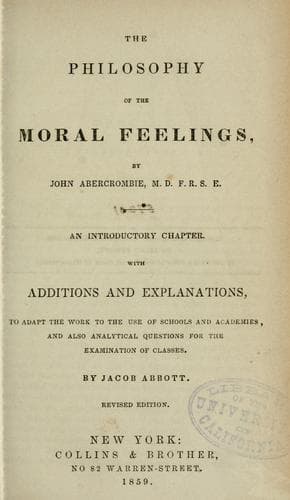
The Philosophy of the Moral FeelingsAbercrombie, John
Religion
The Philosophy of the Moral Feelings
Abercrombie, John
Ethics
class of actions, we cannot avoid the impression that there may be
similar differences respecting others, whenever the decision is left to
a simple process of reason; and we cannot but feel some misgivings, as
to what the state of human society would be, if men, in their moral
decisions were kept together by no other ties than the speculations of
each individual respecting general utility. In any such process, we can
see no provision for that uniformity of feeling required for the class
of actions in which are concerned our moral decisions;--and I can see
nothing unphilosophical in the belief, that the Creator has provided, in
reference to these, a part or a process in our moral constitution, which
is incapable of analysis,--but which proves, as Butler has termed it, "a
rule of right within, to every man who honestly attends to it."
To this view of the subject I would add only one consideration, which
alone appears to present an insurmountable objection to the doctrine of
utility in all its modifications; namely, that any correct ideas of the
utility of an action can be derived only from experience. The study of
the principles of morality, therefore, would consist of a series of
observations or experiments, by which valid conclusions might be
ascertained; and an individual, entering upon the momentous question,
would require either to trust to the conclusions of others, or to make
the observations and experiments for himself. In the former case, he
could not fail to perceive the precarious nature of the basis on which
he was receiving principles of such weighty importance. He could not
fail to remark, that, in other sciences, unsound and premature
deductions had been brought forward, even on high authority, and allowed
to usurp the place of truth. How is he to be satisfied, that, in this
highest of all inquiries, similar errors had not been committed. To
avoid such uncertainty, he may resolve to make the observations or
experiments for himself, and to trust only to his own conclusions. But
here he is met by another difficulty of appalling magnitude. For a
lifetime may not suffice to bring the experiments to a close; and,
during this, he must remain in the same uncertainty on the great
principles of morals, as respecting the periods of a comet, which,
having been seen for a day, darts off into its eccentric orbit, and may
not return for a century. How can it accord with our convictions of the
wisdom of Him who made us, that he should have made us thus.
Public-domain text, read in full here on John Shaqi.
Reviews
Reviews
No reviews yet
Be the first to share your thoughts on this work.
Elsewhere in the archive
Join the Discussion
Join the discussion
Sign in to leave a comment or review.
Sign InorCreate an account