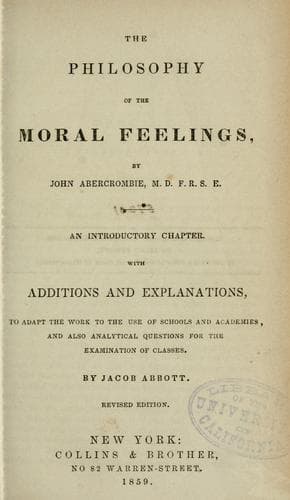
The Philosophy of the Moral FeelingsAbercrombie, John
Religion
The Philosophy of the Moral Feelings
Abercrombie, John
Ethics
The foundation of all these _Theories of Morals_, then, seems to be the
impression, that there is nothing right or wrong, just or unjust in
itself; but that our ideas of right and wrong, justice and injustice,
arise either from actual law or mutual compact, or from our view of the
tendencies of actions. Another modification of these theories, liable,
as it is sometimes stated, to similar objection, ascribes the origin of
right and wrong directly to the will of the Deity, and holds that there
is nothing wrong which might not have been right, if he had so ordained
it.
By the immutability of moral distinctions, as opposed to these theories,
we mean,--that there are certain actions which are immutably right, and
which we are bound in duty to perform, and certain actions which are
immutably wrong, apart from any other consideration whatever;--and that
an absolute conviction of this is fixed upon us, in the moral principle
or conscience, independently of knowledge derived from any other source
respecting the will or laws of the Almighty. This important distinction
has been sometimes not unaptly expressed by saying of such
actions,--not that they are right because the Deity has commanded
them,--but that he has commanded them because they are right. By this
system, therefore, which refers our moral impressions to the supreme
authority of conscience, a principle is disclosed, which, independently
even of revelation, not only establishes an absolute conviction of the
laws of moral rectitude, but leads us to the impression of moral
responsibility and a moral Governor; and as immediately flowing from
this, a state of future retribution. We have already shewn this to
accord with the declarations of the sacred writings, and it is evidently
the only system on which we can account for that uniformity of moral
sentiment which is absolutely required for the harmonies of society. For
it is, in fact, on a conviction of this feeling in ourselves, and of the
existence of a similar and universal principle in others, that is
founded all the mutual confidence which keeps mankind together. It is
this reciprocity of moral feeling that proves a constant check upon the
conduct of men in the daily transactions of life; but, to answer this
purpose, there is evidently required an impression of its
uniformity,--or a conviction that the actions, which we disapprove in
others will be condemned in us by the unanimous decision of other men.
It is equally clear that we have no such impression of a uniformity of
sentiment on any other subject, except on those referable to the class
of first truths; and this immediately indicates a marked distinction
between our moral impressions, and any of those conclusions at which we
arrive by a process of the understanding. It is clear, also, that this
uniformity can arise from no system, which either refers us directly to
the will of God, or is liable to be affected by the differences which
Public-domain text, read in full here on John Shaqi.
Reviews
Reviews
No reviews yet
Be the first to share your thoughts on this work.
Elsewhere in the archive
Join the Discussion
Join the discussion
Sign in to leave a comment or review.
Sign InorCreate an account