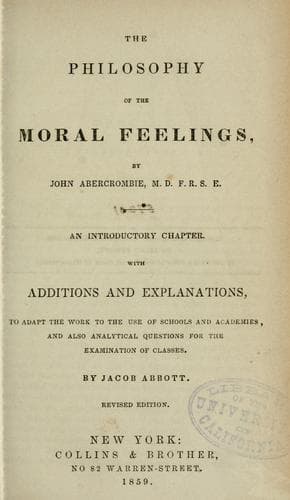
The Philosophy of the Moral FeelingsAbercrombie, John
Religion
The Philosophy of the Moral Feelings
Abercrombie, John
Ethics
may exist in the judgment, the moral taste, the personal feelings, or
the interests of different individuals. It must be, in itself, fixed and
immutable, conveying an absolute conviction which admits of no doubt and
no difference of opinion. Such is the great principle of conscience.
However its warnings may be neglected, and its influence obscured by
passion and moral degradation, it still asserts its claim to govern the
whole man. "Had it strength," says Butler, "as it had right; had it
power, as it had manifest authority, it would absolutely govern the
world."
* * * * *
In opposition to this belief of a uniformity of moral feeling, much
importance has been attached to the practices of certain ancient and
some barbarous nations, as the encouragement of theft in Sparta, and the
exposure of the aged among certain tribes in India. Such instances prove
no diversity of moral feeling; but a difference of practice, arising
from certain specialities, real or supposed, by which, in the particular
cases, the influence of the primary moral feeling is, for the time, set
aside. It is of no importance to the argument, whether the disturbing
principle thus operating be the result of an absurd local policy or a
barbarous superstition. It is enough that we see a principle, which, in
point of fact, does thus operate, suspending, in the particular
instances, the primary moral impression. It was not that, in Sparta,
there was any absence of the usual moral feeling in regard to theft in
the abstract,--but that the cultivation of habits of activity and
enterprise, which arose from the practice, was considered as a national
object of the highest importance, in a small and warlike state,
surrounded by powerful enemies. It is precisely in the same manner,
that, in individual conduct, a man may be misled by passion or by
interest to do things which his sober judgment condemns. In doing so,
there is no want of the ordinary moral feeling which influences other
men; but he has brought himself to violate this feeling, for certain
purposes which he finds to be highly desirable; and then, probably,
seeks to defend his conduct to the satisfaction of his own mind, and of
the minds of others. He has a distinct perception of what is right,
while he does what is wrong. There are numerous facts which illustrate
the same principle, and shew the recognition of correct moral feelings,
even in those who habitually and daringly violate them;--as the laws of
honour and honesty which robbers observe towards each other,--and the
remarkable fidelity of smugglers towards their associates. In some of
the tribes in the South Seas, also, most remarkable for their
dishonesty, it was found, that while they encouraged each other in
pillaging strangers, theft was most severely punished among themselves.
Need I farther refer, on this subject, to the line of argument adopted
in the great question of slavery. It is directed to the palliating
Public-domain text, read in full here on John Shaqi.
Reviews
Reviews
No reviews yet
Be the first to share your thoughts on this work.
Elsewhere in the archive
Join the Discussion
Join the discussion
Sign in to leave a comment or review.
Sign InorCreate an account