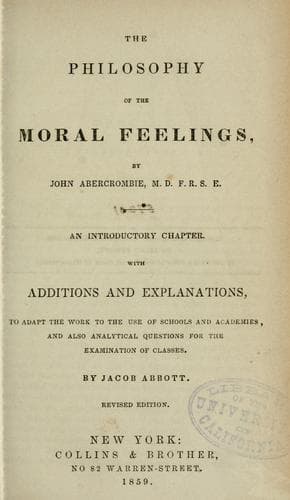
The Philosophy of the Moral FeelingsAbercrombie, John
Religion
The Philosophy of the Moral Feelings
Abercrombie, John
Ethics
It remains only that we briefly notice the system of Dr. Adam Smith,
commonly called the theory of Sympathy. According to this ingenious
writer, it is required for our moral sentiments respecting an action,
that we enter into the feelings both of the agent, and of him to whom
the action relates. If we sympathize with the feelings and intentions of
the agent, we approve of his conduct as right,--if not, we consider it
as wrong. If, in the individual to whom the action refers, we sympathize
with a feeling of gratitude, we regard the agent as worthy of
praise,--if with a feeling of resentment, the contrary. We thus observe
our feelings respecting the conduct of others, in cases in which we are
not personally concerned,--then apply these rules to ourselves, and thus
judge of our own conduct. This very obvious statement, however, of what
every man feels, does not supply the place of a fundamental rule of
right and wrong; and indeed Dr. Smith does not appear to contend that it
does so. It applies only to the application of a principle, not to the
origin of it. Our sympathy can never be supposed to constitute an action
right or wrong; but it enables us to apply to individual cases a
principle of right and wrong derived from another source;--and to clear
our judgment in doing so, from the blinding influence of those selfish
feelings by which we are so apt to be misled when we apply it directly
to ourselves. In estimating our own conduct, we then apply to it those
conclusions which we have made with regard to the conduct of others,--or
we imagine others applying the same process in regard to us, and
consider how our conduct would appeal to an impartial observer.
* * * * *
This, however, is a most important principle in regard to our moral
decisions,--namely, the process by which we view an action, or a course
of conduct, in another, and then apply the decision to ourselves. When
the power of moral judgment is obscured or deadened in regard to our own
conduct, by self-love or deranged moral habits, all the correctness of
judgment is often preserved respecting the actions of others. It is thus
that men are led on by interest or passion into courses of action,
which, if viewed calmly and dispassionately, they would not deliberately
defend even in themselves, and which, when viewed in others, they
promptly condemn. This principle is beautifully illustrated in the
sacred writings, when the prophet went to the king of Israel, and laid
before him the hypothetical case of a rich man, who had committed an act
of gross and unfeeling injustice against a poor neighbour. The monarch
was instantly roused to indignation, and pronounced a sentence of
severe but righteous vengeance against the oppressor,--when the prophet
turned upon him with the solemn denunciation, "Thou art the man." His
moral feeling in regard to his own conduct was dead; but his power of
correct moral decision when applied to another was undiminished.
Public-domain text, read in full here on John Shaqi.
Reviews
Reviews
No reviews yet
Be the first to share your thoughts on this work.
Elsewhere in the archive
Join the Discussion
Join the discussion
Sign in to leave a comment or review.
Sign InorCreate an account