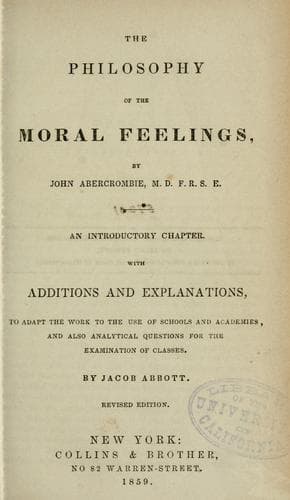
The Philosophy of the Moral FeelingsAbercrombie, John
Religion
The Philosophy of the Moral Feelings
Abercrombie, John
Ethics
* * * * *
In regard to the whole of this subject, an important distinction is to
be made between the fundamental principle, from which actions derive
their character of right and wrong,--and the application of reason in
judging of their tendencies. Before concluding this part of the subject,
therefore, we have to add a very few observations on the influence
exerted on our moral decisions by reason,--always however in
subserviency to the great principle of conscience. The office of reason
appears to be, in the first place, to judge of the expediency,
propriety, and consequences of actions, which do not involve any feeling
of moral duty. In regard to the affections, again, a process of reason
is often necessary, not only respecting the best mode of exercising
them, but also, in many cases, in deciding whether we shall exercise
them at all. Thus, we may feel compassion in a particular instance, but
perceive the individual to be so unworthy, that what we could do would
be of no benefit to him. In such a case we may feel it to be a matter
not only of prudence, but of duty, to resist the affection, and to
reserve the aid we have to bestow for persons more deserving.
In cases in which an impression of moral duty is concerned, an exercise
of reason is still in many instances, necessary, for enabling us to
adapt our means to the end which we desire to accomplish. We may feel an
anxious wish to promote the interest or relieve the distress of another,
or to perform some high and important duty,--but call reason to our aid
respecting the most effectual and the most judicious means of doing so.
Conscience, in such cases, produces the intention,--reason suggests the
means;--and it is familiar to every one that these do not always
harmonize. Thus a man may be sound in his intentions, who errs in
judgment respecting the means for carrying them into effect. In such
cases, we attach our feeling of moral approbation to the intention
only,--we say the man meant well, but erred in judgment;--and to this
error we affix no feeling of moral disapprobation,--unless, perhaps, in
some cases, we may blame him for acting precipitately on his own
judgment, instead of taking the advice of those qualified to direct him.
We expect such a man to acquire wisdom from experience, by observing the
deficiency of his judgment in reference to his intentions; and, in
future instances, to learn to take advice. There are other circumstances
in which an exercise of reason is frequently brought into action in
regard to moral decisions;--as in some cases in which one duty appears
to interfere with another;--likewise in judging whether, in particular
instances, any rule of duty is concerned, or whether we are at liberty
to take up the case simply as one of expediency or utility. In making
their decisions in doubtful cases of this description, we observe great
differences in the habits of judging in different individuals. One shews
Public-domain text, read in full here on John Shaqi.
Reviews
Reviews
No reviews yet
Be the first to share your thoughts on this work.
Elsewhere in the archive
Join the Discussion
Join the discussion
Sign in to leave a comment or review.
Sign InorCreate an account