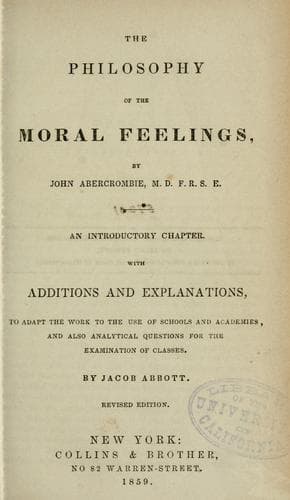
The Philosophy of the Moral FeelingsAbercrombie, John
Religion
The Philosophy of the Moral Feelings
Abercrombie, John
Ethics
On whatever system we may consider the moral feelings, we perceive that
there are various classes of them,--each answering a special purpose in
our relations as accountable beings. Some of them, we have seen, refer
to objects of desire, the attainment of which appears likely to bring
satisfaction. Others lead us to those relations which we bear to our
fellow-men. A third class, which remains to be considered, calls our
attention to the relation in which we stand to the moral Governor of the
universe, and to a certain regulation of the moral feelings arising out
of this relation. But this is still another inquiry of the deepest
interest, connected with this subject, namely, regarding the harmony or
principle of arrangement, which these various classes of moral emotions
ought to bear towards each other. They all form parts of our
constitution, and deserve a certain degree of attention, which must be
carefully adapted to the relative importance of each; and the correct
adjustment of this harmony is one of the objects to be answered by the
moral principle, combined with a sound exercise of judgment. The rules
which apply to it may be stated in the following manner.
When we consider man as an immortal being, passing through a course of
discipline to another state of existence, it is obvious that his highest
consideration is his own moral condition, and the aspect in which he
stands towards the Deity. In immediate connexion with this first of all
concerns are the great and general principles of justice and veracity,
as referring to our connexion with all mankind, and a class of private
responsibilities which peculiarly regard each individual in his domestic
relations; such as the duties of children to then parents, and parents
to their children;--the latter, particularly, presenting a class of the
most solemn kind, as it embraces the concerns of the present life, and
of that which is to come. Then follow the duties of benevolence,
friendship, and patriotism; after these, the ordinary avocations of
life, as the acquisition of knowledge and the pursuits of business; and
finally, those personal recreations and enjoyments, which, when kept in
their proper place, are legitimate and necessary to every human being.
These are all proper and laudable, provided they are kept in a proper
subserviency to each other. But the important consideration is, that a
man maybe acting unworthily of his moral nature, when he devotes himself
to any one of them in a manner which encroaches upon the harmony of the
whole.
Public-domain text, read in full here on John Shaqi.
Reviews
Reviews
No reviews yet
Be the first to share your thoughts on this work.
Elsewhere in the archive
Join the Discussion
Join the discussion
Sign in to leave a comment or review.
Sign InorCreate an account