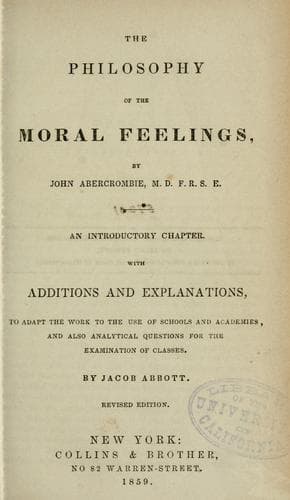
The Philosophy of the Moral FeelingsAbercrombie, John
Religion
The Philosophy of the Moral Feelings
Abercrombie, John
Ethics
It does, I confess, appear to me, that some late excellent and
respectable writers, in their apprehension of not giving sufficient
prominence to the doctrine of human depravity, have greatly under-rated
the actual power of conscience, and have thus injured in a most
essential manner the important argument which is derived from the moral
impressions of the mind. True it is, indeed, that the nature of man is
degenerate, and that the effect of this appears in his disregarding and
disobeying that monitor within. I am not disposed to differ from the
writers referred to, respecting the existence and the extent of this
degeneracy, but rather as to the manner in which it operates in the
actual moral condition of mankind. I do not say that there is in human
nature more good than they assign to it, but that there is more
knowledge of what is good; not that men do better than these writers
allege, but that they have a greater sense of what they ought to do.
Those who maintain the absolute and unusual corruption of conscience may
also be reminded of the remarkable differences which are admitted to
exist in different men, and the manner in which moral feeling is
gradually obscured or overpowered by a course of personal depravity. The
facts are universally admitted respecting the contest with moral
principle which attends the first stages of vice, and the remorse which
follows. But after each departure from virtue, this opposing influence
is progressively weakened, and at length destroyed. In this progress,
then, we must admit two distinct conditions of the moral feelings,--one
in which conscience distinctly points at what is right, however its
warnings may be disregarded,--and another in which its warning influence
is weakened or lost. In the former condition, I think we may affirm that
it asserts its right and its authority, though its strength and its
power are departed; and it does not appear to be saying too much, if we
say in the striking language of Butler, "had it strength as it had
right,--had it power as it had manifest authority, it would absolutely
govern the world."
Sec. II.--OF THE HARMONY OF THE MORAL FEELINGS.
Public-domain text, read in full here on John Shaqi.
Reviews
Reviews
No reviews yet
Be the first to share your thoughts on this work.
Elsewhere in the archive
Join the Discussion
Join the discussion
Sign in to leave a comment or review.
Sign InorCreate an account