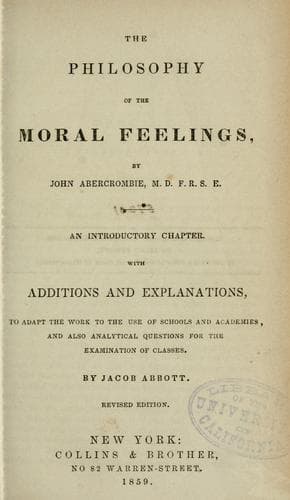
The Philosophy of the Moral FeelingsAbercrombie, John
Religion
The Philosophy of the Moral Feelings
Abercrombie, John
Ethics
It is scarcely necessary to add, on the other hand, that attention to
this first of all concerns must not be allowed to estrange the mind from
the various duties and responsibilities of active life. It is only,
indeed, when the conduct is regulated by partial and unsound motives,
that some of these objects of attention are allowed to usurp the place
of others. He who acts, not from the high principles of moral duty, but
from a desire of notoriety, or the applause of men, may devote himself
to much benevolence and usefulness of a public and ostensible kind;
while he neglects duties of a higher, though more private nature,--and
overlooks entirely, it may be, his own moral condition. The ascetic, on
the contrary, shuts himself up in his cell, and imagines that he
pleases God by meditation and voluntary austerities. But this is not the
part of him who truly feels his varied relations, and correctly
estimates his true responsibilities.--It is striking, also, to remark,
how the highest principles lead to a character of harmony and
consistency, which all inferior motives fail entirely in producing. The
man, who estimates most deeply and correctly his own moral relations to
an ever-present and presiding Deity, will also feel his way through the
various duties of life, with a degree of attention adapted to each of
them. In the retirements of domestic life, he is found in the anxious
discharge of the high responsibilities which arise out of its relations.
He is found in the path of private benevolence and public usefulness,
manifesting the kind and brotherly interest of one who acts on the
purest of all motives,--the love of God, and a principle of devotedness
to his service. Whether exposed to the view of his fellow-men, or seen
only by Him who seeth in secret, his conduct is the same,--for the
principles on which he acts have, in both situations, equal influence.
In the ordinary concerns of life, the power of these principles is
equally obvious. Whether he engage in its business, or partake of its
enjoyments;--whether he encounter its difficulties, or meet its pains,
disappointments, and sorrows,--he walks through the whole with the calm
dignity of one who views all the events of the present life, in then
immediate reference to a life which is to come.
* * * * *
Public-domain text, read in full here on John Shaqi.
Reviews
Reviews
No reviews yet
Be the first to share your thoughts on this work.
Elsewhere in the archive
Join the Discussion
Join the discussion
Sign in to leave a comment or review.
Sign InorCreate an account