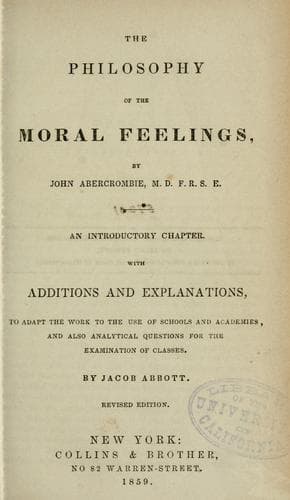
The Philosophy of the Moral FeelingsAbercrombie, John
Religion
The Philosophy of the Moral Feelings
Abercrombie, John
Ethics
The high consistency of character, which results from this regulated
condition of the moral feelings, tends thus to promote a due attention
to the various responsibilities connected with the situation in which
the individual is placed. It does so, by leading him, with anxious
consideration, to feel his way through these requirements, and to
recognise the supreme authority of conscience over his whole moral
system. It does so, especially, by habitually raising his views to the
eternal One, who is the witness of all his conduct, and to whom he is
responsible for his actions in each relation of life. It thus tends to
preserve him from all those partial and inconsistent courses, into which
men are led by the mere desire of approbation, or love of distinction,
or by any other of those inferior motives which are really resolvable
into self-love.
Such uniformity of moral feeling is equally opposed to another
distortion of character, not less at variance with a sound condition of
the mind. This is what may be called religious pretension, showing
itself by much zeal for particular opinions and certain external
observances, while there is no corresponding influence upon the moral
feelings and the character. The truths, which form the great object of
religious belief, are of so momentous a kind, that, when they are really
believed, they cannot fail to produce effects of the most decided and
most extensive nature;--and, where this influence is not steadily
exhibited, there is a fatal error in the moral economy,--there is either
self-deception, or an intention to deceive others. From such
inconsistency of character arises an evil, which has a most injurious
influence upon two descriptions of persons. Those of one class are led
to assign an undue importance to the profession of a peculiar creed and
the mere externals of religion,--to certain observations which are
considered as characteristic of a particular party, and to abstinence
from certain indulgences or pursuits which that party disapprove. Those
of the other class, finding, in many instances, much zeal for these
peculiarities, without a state of moral feeling adapted to the truths
which are professed, are apt to consider the whole as either pretence or
delusion.
Public-domain text, read in full here on John Shaqi.
Reviews
Reviews
No reviews yet
Be the first to share your thoughts on this work.
Elsewhere in the archive
Join the Discussion
Join the discussion
Sign in to leave a comment or review.
Sign InorCreate an account