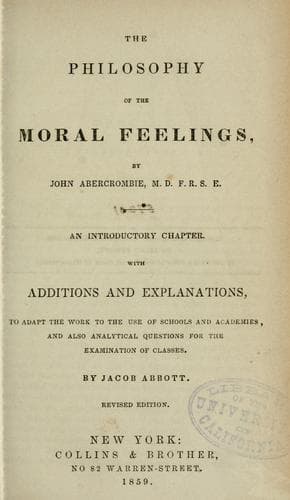
The Philosophy of the Moral FeelingsAbercrombie, John
Religion
The Philosophy of the Moral Feelings
Abercrombie, John
Ethics
The healthy state of a moral being is strikingly referred, in the sacred
writings, to three great heads,--justice,--benevolence,--and a
conformity of the moral feelings to a reverential sense of the presence
and perfections of the Deity;--"to do justly, to love mercy, and to walk
humbly with thy God." The two former of these considerations lead us to
the duties which a man owes to his fellow-men;--the latter calls our
attention to that homage of the mind and of the heart which he owes
peculiarly to God. For the duties of the former class we are equally
responsible to him, as the moral Governor of the universe, but their
immediate reference is to our connexions with other men;--those of the
latter class respect our relation to the Deity himself, and consequently
consist, in a great measure, in the purity and devotedness of the mind.
In human systems of ethics, attention has been chiefly directed to the
obligations of social and relative morality;--but the two classes are
closely associated in the sacred writings; and the sound condition of
the moral feelings is pointed out as that acquirement which, along with
a corresponding integrity of character, qualifies man, in an especial
manner, for intercourse with the Deity. "Who shall ascend unto the hill
of the Lord, or who shall stand in his holy place. He that hath clean
hands and a pure heart, who hath not lifted up his soul unto vanity, nor
sworn, deceitfully."--"Blessed are the pure in heart, for they shall see
God."
Such declarations challenge the assent and absolute conviction of every
sound understanding. Are we, as responsible creatures, placed in
immediate relation to a great moral Governor, a being of infinite purity
and boundless perfections:--Is the structure of our bodies, and the
still more wonderful fabric of our minds, alike the work of his
hand:--Then it is impossible to put away from us the impression,--that
each movement of these minds must be fully exposed to his inspection. It
is equally impossible to repel from us the solemn truth,--that it is by
the desires, the feelings, and the motives of action which exist there,
that our condition is to be estimated in his sight,--and that a man,
whose conduct to his fellow-men does not violate propriety and justice,
may be in a state of moral degradation in the eyes of him who seeth in
secret;--"for," says the sacred writer, "man looketh on the outward
appearance, but the Lord looketh on the heart."
There cannot, therefore, be an inquiry of more intense interest, than
what is that condition of the heart and of the mind which every man
ought to seek after, when he considers himself as exposed to the
continual inspection of the Almighty. It may, perhaps, be briefly
referred to the following heads.
Public-domain text, read in full here on John Shaqi.
Reviews
Reviews
No reviews yet
Be the first to share your thoughts on this work.
Elsewhere in the archive
Join the Discussion
Join the discussion
Sign in to leave a comment or review.
Sign InorCreate an account