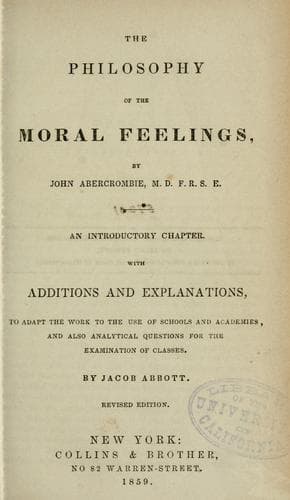
The Philosophy of the Moral FeelingsAbercrombie, John
Religion
The Philosophy of the Moral Feelings
Abercrombie, John
Ethics
forfeit the esteem of those whose approbation he values, he will submit
to much personal exertion, and sacrifice much selfish advantage, which
others might deem highly worthy of attainment. But all this may go on
without any recognition of divine authority; and may all exist in a man
in whom there is much impurity of desire, and much deficiency of moral
feeling. It is all referable to a motive of a personal nature, and, in
the gratification of this, his ruling principle is satisfied.
The state of mind which is under the influence of a habitual sense of
the divine presence may, therefore, be considered under two
relations,--the one referring more immediately to the Deity,--the other
to our fellow-men. The former seems chiefly to include an effort to have
every desire, thought, and imagination of the heart, regulated by a
sense of the presence and the purity of God, and in conformity to his
will. Amid much feeling of deficiency in these respects, it leads our
attention to that interesting mental condition, in which there is a
contest and a warfare within,--and a prevailing opposition to every
thing that is at variance with the purity of a moral being. The second
division includes the cultivation of feelings of kindness and
benevolence towards all men;--the love of justice,--the love of
truth,--the love of peace,--the forgiveness of injuries,--the
mortification of selfishness;--in a word, the earnest and habitual
desire to promote the comfort and alleviate the distresses of others.
From these two mental conditions must spring a character, distinguished
alike by piety towards God, and by high integrity, benevolence, and
active usefulness towards man. He who earnestly cultivates this purity
within, feels that he requires continual watchfulness, and a constant
direction of the mind to those truths and moral causes which are
calculated to influence his volitions. He feels farther that he is in
need of a might not his own in this high design; but for this he knows
also he can look, with humble confidence and hope, when, under a sense
of moral weakness, he asks its powerful aid.
Public-domain text, read in full here on John Shaqi.
Reviews
Reviews
No reviews yet
Be the first to share your thoughts on this work.
Elsewhere in the archive
Join the Discussion
Join the discussion
Sign in to leave a comment or review.
Sign InorCreate an account