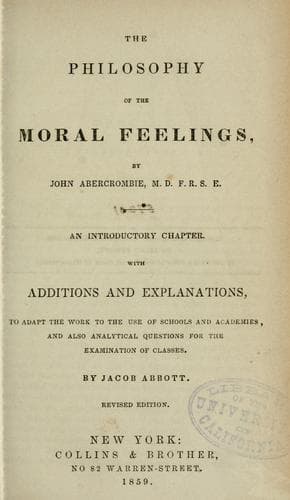
The Philosophy of the Moral FeelingsAbercrombie, John
Religion
The Philosophy of the Moral Feelings
Abercrombie, John
Ethics
There are, accordingly, two classes of characters clearly pointed out in
the sacred writings,--namely, one in whom the conduct indicates the
depravity within,--and another, in whom the external character preserves
a respectable aspect in the estimation of men, while the moral feelings
are in a corrupted condition in the sight of God. We have formerly
endeavoured to trace the laws to which this fact is to be referred, on
the principles of the philosophy of the human mind:--they are chiefly
two: (1.) We have seen that there are original principles in our nature
which lead to a certain exercise of justice, veracity, and benevolence,
independently of any recognition of divine authority. They are a part of
our moral constitution, and calculated to promote important purposes in
the harmony of human society; and they carry along with them a certain
principle of reciprocal compensation, which is entirely distinct from
any impression of their moral aspect. The man who is deficient in them,
indeed, incurs guilt; but a certain discharge of them may arise from
mere natural, or even selfish feeling, unconnected with any sense of
responsibility; and this consequently conveys no impression of moral
approbation. In the very exercise of them a man receives his reward,
partly by a feeling of satisfaction, which from the constitution of his
nature, they are calculated to yield, and partly as a member of that
community where they promote peace, and order, and harmony; and he is
not entitled to look farther, or to claim from them any feeling of merit
in the sight of the Deity. (2.) A second principle, which bears an
important relation to this subject, is the manner in which a man's
character is influenced by the particular motive or pursuit to which he
has resigned the guidance of his conduct. One surrenders himself to the
animal propensities, and becomes a selfish profligate, insensible to
every right principle of action, while his depraved condition is obvious
to all around him. A second devotes himself to ambition;--and a third to
avarice:--These ruling passions, it may be, are found to be adverse to
the selfish indulgence and open profligacy of the former; and a
character may arise out of them distinguished by much that is decent,
and respectable, and worthy of approbation in the eye of man. In a
fourth, the ruling motive may be the desire of esteem and approbation;
and this may, and often does, become a principle of such influence, as
to overpower, in a great measure, the selfish propensities, and to
produce a character estimable not only for justice and veracity, but a
high degree of active benevolence. Such a man sacrifices to his ruling
passion much that might be turned to the purposes of ambition, avarice,
or selfish indulgence, by those who are guided by these propensities;
and, in doing so, he has his reward. He finds it in the gratification of
that principle which in him has become predominant; and, rather than
Public-domain text, read in full here on John Shaqi.
Reviews
Reviews
No reviews yet
Be the first to share your thoughts on this work.
Elsewhere in the archive
Join the Discussion
Join the discussion
Sign in to leave a comment or review.
Sign InorCreate an account