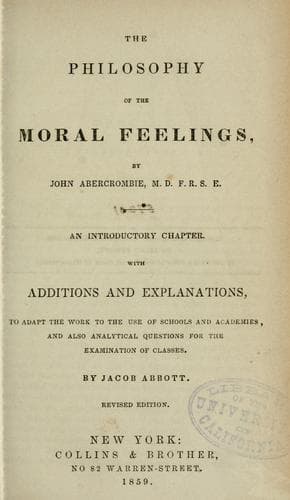
The Philosophy of the Moral FeelingsAbercrombie, John
Religion
The Philosophy of the Moral Feelings
Abercrombie, John
Ethics
III. A sense of moral imperfection and guilt,--and that humility and
devout self-abasement which arise out of it. This must be a prominent
feeling in every one who views his own conduct, and his mental emotions,
in reference to the purity of God. It naturally leads to supplication
for his mercy and forgiveness; and, in the wondrous display of his
character, given in the sacred writings, a provision is disclosed, in
virtue of which the exercise of mercy is made consistent with the truth
and justice of a moral governor. This dispensation of peace we find
habitually represented as adapted to man in a state of spiritual
destitution: and no mental condition is more frequently referred to, as
acceptable with the Deity, than that which consists of contrition and
lowliness of mind.--"Thus sayeth the high and lofty One that inhabiteth
eternity, whose name is Holy; I dwell in the high and holy place, with
him also that is of a contrite and humble spirit,--to revive the spirit
of the humble, and to revive the heart of the contrite ones." With this
state of mind is very naturally associated a sense of moral
weakness,--and a constant reliance on divine aid, both for direction
through life, and for the culture of the moral being.
IV. It is only necessary to add,--a profound sense of gratitude and love
towards the Deity as the giver of all good,--as our daily preserver and
benefactor. These feelings will have a special reference to the display
which he has given of his character, as merciful, gracious, and slow to
anger; and to the provision which he has made for the recovery and
restoration of his fallen creatures, through "God manifest in the
flesh." Of this divine person, and the work which he came to accomplish,
philosophy presumes not to speculate;--but we have seen the light
afforded, by the inductions of moral science, respecting the probability
of this revelation,--and its adaptation to the actual state of man in
his relation to the Deity. We have seen the impression conveyed by the
character of the Messiah, considered merely as matter of historical
truth,--exhibiting such a pattern, as never appeared in our world,
except in him, of a pure and perfect moral being. We have seen, farther,
the incontrovertible nature of that evidence, transmitted by testimony,
and confirmed, as it is, in a very peculiar manner, by periodical
observances, on which the whole revelation is supported;--and the
inductions of sound philosophy harmonize with the impressions of the
man, who, feeling his own moral necessities, yields his cordial assent
to this mystery of God, and seeks in its provisions his peace in the
life that now is, and his hope for the life that is to come.
* * * * *
Public-domain text, read in full here on John Shaqi.
Reviews
Reviews
No reviews yet
Be the first to share your thoughts on this work.
Elsewhere in the archive
Join the Discussion
Join the discussion
Sign in to leave a comment or review.
Sign InorCreate an account