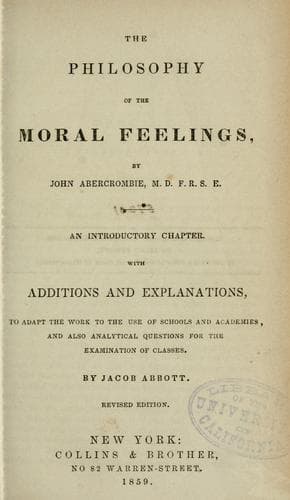
The Philosophy of the Moral FeelingsAbercrombie, John
Religion
The Philosophy of the Moral Feelings
Abercrombie, John
Ethics
From the whole mental condition, thus slightly delineated, there will
naturally arise a character and conduct adapted to the feelings and
principles which rule within. This implies, as we have seen, a due
regulation of the desires, and a habitual direction of them to objects
of real and adequate importance,--a diligent cultivation and exercise of
all the affections,--and a conduct distinguished, in the highest degree,
by purity, integrity, veracity, and active benevolence. It implies a
profound submission to the will of the Almighty, which puts to silence
every murmuring or repining thought under any dispensation of his
providence. It comprehends the habitual suppression of every selfish
principle, and the constant aspiration after a state of moral feeling,
which proposes to itself no lower standard than that which will bear the
inspection of a being of infinite purity. This character seems to
correspond with that high tone of morals enjoined in the sacred
writings. Its elements are defined and clear;--would we seek to estimate
its sublimity and its truth, we have only to compare it with those
distorted and temporizing systems which have resulted from the
inventions of men. A feeling of dissatisfaction, the same in kind,
though it may differ in degree, will attach to them all; and there is
none in which we can confidently rest, until we rise to the sublime
morality of the gospel. That great system of ethical purity comes to us
under the sanction of divine revelation, and established by the
miraculous evidence by which the proof of this is conveyed; but it is
independent of any other support than that which it carries in
itself,--consistency with the character of God,--and harmony with the
best feelings of man. In yielding an absolute consent to its supreme
authority, we require no external evidence. We have only to look at the
record in its own majestic simplicity, tried by the highest inductions
of the philosophy of the moral feelings, to enable us to point to the
morality of the gospel, and to say with unshrinking confidence,--this is
truth.
Public-domain text, read in full here on John Shaqi.
Reviews
Reviews
No reviews yet
Be the first to share your thoughts on this work.
Elsewhere in the archive
Join the Discussion
Join the discussion
Sign in to leave a comment or review.
Sign InorCreate an account