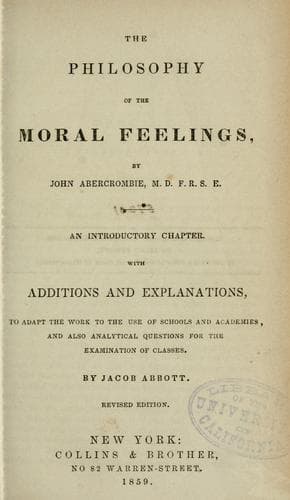
The Philosophy of the Moral FeelingsAbercrombie, John
Religion
The Philosophy of the Moral Feelings
Abercrombie, John
Ethics
The restoration of man from a state of estrangement, anarchy, or moral
death, we are taught in the sacred writings to refer to a power from
without the mind,--an influence directly from God. We have seen the
various considerations derived from the phenomena of the mind, and our
impressions of the divine character, giving to this great doctrine a
probability which claims the assent of every correct understanding. But,
without in any degree losing sight of the truth and the importance of
this principle, the immediate object of our attention, as a branch of
mental science, is rather the process of the mind itself, by means of
which a habitual influence is produced upon the whole character. This is
a compound operation which may probably be analysed in the following
manner. It seems to be composed of reason,--attention,--and a
modification of conception. The province of Reason is to examine the
truth of the statements or doctrines, which are proposed to the mind, as
calculated to act upon its moral feelings;--and, upon this being done in
a correct manner, must depend the validity of the subsequent parts of
the mental process. This being premised, it is the office of Attention,
aided by reason, to direct the mind assiduously to the truths, so as
fully to perceive their relations and tendencies. By the farther
process, analogous to Conception, they are then placed before us, in
such a manner as to give them the effect of real and present existence.
By these means, truths relating to things for which we have not the
evidence of our senses, or referring to events which are future, but
fully expected to happen, are kept before the mind, and influence the
moral feelings and the character, in the same manner as if the facts
believed were actually seen, or the events expected were taking place in
our view. This mental operation is _Faith_;--and, for the sound exercise
of it, the constituent elements now mentioned are essentially necessary.
The truth must be received by the judgment upon adequate evidence; and,
by the other parts of the process, it must be so kept before the mind,
that it may exercise such a moral influence as might arise from the
actual vision or present existence, of the things believed.
Public-domain text, read in full here on John Shaqi.
Reviews
Reviews
No reviews yet
Be the first to share your thoughts on this work.
Elsewhere in the archive
Join the Discussion
Join the discussion
Sign in to leave a comment or review.
Sign InorCreate an account