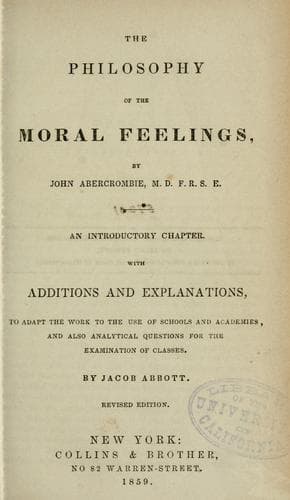
The Philosophy of the Moral FeelingsAbercrombie, John
Religion
The Philosophy of the Moral Feelings
Abercrombie, John
Ethics
important reference to the life which is to come;--he inquires for a
discernment of the ways of Divine Providence, as he either feels it in
his own concerns, or views it in the chain of events which are going on
in the world around him. He learns to trace the whole to the same
unerring hand which guides the planet in its course; and thus rests in
the absolute conviction that the economy of Providence is one great and
magnificent system of design and order and harmony. These, we repeat
with confidence, are no visions of the imagination, but the sound
inductions of a calm and rational philosophy. They are conclusions which
compel the assent of every candid inquirer, when he follows out that
investigation of mighty import,--what is God,--and what is that essence
in man which he has endowed with the power of rising to himself.
To enlarge upon these important subjects would lead us away from the
proper design of a work, which is intended chiefly to investigate the
light we derive from the phenomena of the mind itself. The points which
have been stated, as arising out of the impressions of every sound
understanding, challenge the assent of all who believe in a present and
presiding Deity,--a being of infinite power and wisdom, and of perfect
purity. With him who calls in question this sublime truth, we have no
common feeling, and no mutual premises on which an argument can be
founded. We must therefore leave him to sit in solitary pride, while he
views the chaos which his fancy has framed, and strives to reconcile the
discordant elements of a system, in which there are effects without a
cause, and harmony without a regulating power; and in which the mind can
perceive no element of credibility, consistency, or truth.
With this slight outline, therefore, we must quit a subject of the
deepest interest, but which belongs rather to the theologian than to the
inquirer in mental science;--and proceed briefly to investigate the
means by which the condition of the moral feelings, which has been the
subject of the preceding observations, may be promoted and cultivated as
the regulating principle of the whole character. Two views may be taken
of this point, which, though they harmonize with each other in practice,
are to be considered in their philosophical aspect as distinct.
Public-domain text, read in full here on John Shaqi.
Reviews
Reviews
No reviews yet
Be the first to share your thoughts on this work.
Elsewhere in the archive
Join the Discussion
Join the discussion
Sign in to leave a comment or review.
Sign InorCreate an account