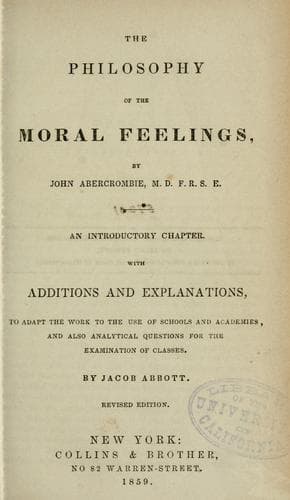
The Philosophy of the Moral FeelingsAbercrombie, John
Religion
The Philosophy of the Moral Feelings
Abercrombie, John
Ethics
When a truth has fully received the sanction of the judgment, the second
office of faith is, by attention and conception, to keep it habitually
before the mind, so that it may produce its proper influence upon the
character. This is to live by faith;--and in this consists that
operation of the great principle, which effectually distinguishes it
from all pretended feelings and impressions assuming its name. We speak,
in common language, of a head-knowledge which does not affect the
heart;--and of a man who is sound in his creed, while he shews little of
its influence upon his conduct. The mental condition of such a man
presents a subject of intense interest. His alleged belief, it is
probable, consists merely in words, or in arguing ingeniously on points
to which he attaches no real value. These may have been impressed upon
him by education;--they may constitute the creed of a party to which he
has devoted himself; and he may argue in support of them with all the
energy of party zeal. In the same manner, a man may contend warmly in
favour of compassion, whose conduct shows a cold and barren
selfishness;--but this is not benevolence;--and the other is not faith.
Both are empty professions of a belief in certain truths, which have
never fixed themselves in the mind, so as to become regulating
principles or moral causes in the mental constitution. We may indeed
suppose another character, slightly removed from this, in which the
truths have really received the approbation of the judgment, and yet
fail to produce their proper influence. This arises from distorted moral
habits, and a vitiated state of the moral faculties, which have
destroyed the healthy balance of the whole economy of the mind. The
consequence is, that the man perceives and approves of truths, without
feeling their tendencies, and without manifesting their power.
Intimately connected with this subject, also, is a remarkable principle
in our mental constitution, formerly referred to,--the relation between
certain facts or truths, and certain moral emotions, which naturally
arise from them, according to the chain of sequences which has been
established in the economy of the mind. A close connexion thus exists
between our intellectual habits and our moral feelings, which leads to
consequences of the utmost practical moment. Though we have little
immediate voluntary power over our moral emotions, we have a power over
the intellectual processes with which these are associated. We can
direct the mind to truths, and we can cherish trains of thought, which
are calculated to produce correct moral feelings;--and we can avoid or
banish mental images or trains of thought, which have an opposite
tendency. This is the power over the succession of our thoughts, the due
exercise of which forms so important a feature of a well-regulated mind,
in regard to intellectual culture;--its influence upon us as moral
beings is of still higher and more vital importance.
Public-domain text, read in full here on John Shaqi.
Reviews
Reviews
No reviews yet
Be the first to share your thoughts on this work.
Elsewhere in the archive
Join the Discussion
Join the discussion
Sign in to leave a comment or review.
Sign InorCreate an account