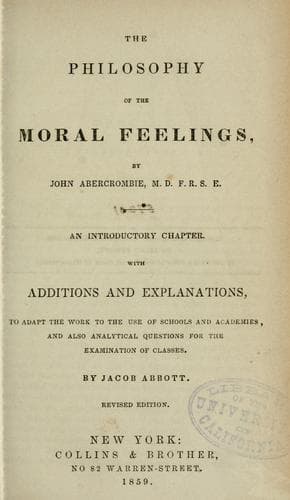
The Philosophy of the Moral FeelingsAbercrombie, John
Religion
The Philosophy of the Moral Feelings
Abercrombie, John
Ethics
The sound exercise of that mental condition which we call Faith
consists, therefore, in the reception of certain truths by the
judgment,--the proper direction of the attention to their moral
tendencies,--and the habitual influence of them upon the feelings and
the conduct. When the sacred writers tell us that, without faith, it is
impossible to please God,--and when they speak of a man being saved by
faith,--it is not to a mere admission of certain truths as part of his
creed, that they ascribe consequences so important; but to a state in
which these truths are uniformly followed out to certain results, which
they are calculated to produce, according to the usual course of
sequences in every sound mind. This principle is strikingly illustrated
by one of these writers, by reference to a simple narrative. During the
invasion of Canaan by the armies of Israel, two men were sent forward as
spies to bring a report concerning the city of Jericho. The persons
engaged in this mission were received in a friendly manner, by a woman
whose house was upon the wall of the city;--when their presence was
discovered, she hid them from their pursuers; and finally enabled them
to escape, by letting them down by a cord from a window. Before taking
leave of them, she expressed her firm conviction, that the army to which
they belonged was soon to take possession of Jericho, and of the whole
country, and she made them swear to her that, when this should take
place, they would shew mercy to her father's house. The engagement was
strictly fulfilled. When the city was taken, and the other inhabitants
destroyed, the woman was preserved, with all her kindred. In this very
simple occurrence, the woman is represented, by the sacred writer, as
having been saved by faith. The object of her faith was the event which
she confidently expected,--that the city of Jericho was to be destroyed.
The ground of her faith was the rapid manner in which the most powerful
nations had already fallen before the armies of Israel,--led, as she
believed, by a divine power. Acting upon this conviction, in the manner
in which a belief so deeply affecting her personal safety was likely to
influence any sound mind, she took means for her preservation, by making
friends of the spies. Her faith saved her, because without it she would
not have made this provision; but, unless she had followed out her
belief to the measure which was calculated to effect this object, the
mere belief of the event would have availed her nothing. When we
therefore ascribe important results to faith, or to any other mental
operation, we ascribe them not to the operation itself, but to this
followed out to the consequences which it naturally produces, according
to the constitution of the human mind. In the same manner, we may speak
of one man, in a certain state of danger or difficulty, being saved by
his wisdom, and another by his strength. In doing so, we ascribe such
Public-domain text, read in full here on John Shaqi.
Reviews
Reviews
No reviews yet
Be the first to share your thoughts on this work.
Elsewhere in the archive
Join the Discussion
Join the discussion
Sign in to leave a comment or review.
Sign InorCreate an account