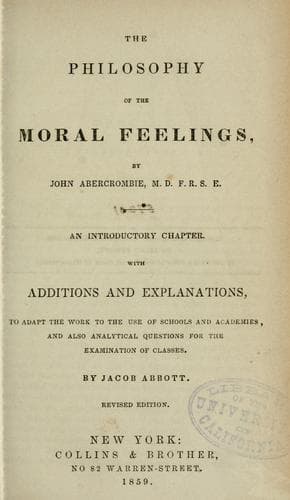
The Philosophy of the Moral FeelingsAbercrombie, John
Religion
The Philosophy of the Moral Feelings
Abercrombie, John
Ethics
These truths are not the visions of enthusiasm; neither are they the
result of any process of reasoning, by which different men may arrive
at different conclusions. They force themselves upon our conviction with
a power which we cannot put away from us, when we turn our attention to
the solemn inquiry, what we are, and what is God. In the sacred writings
they are detailed and illustrated, in a connected and harmonious manner;
and are impressed upon us with the force of a revelation from the Deity
himself. But the principles there disclosed meet with an impression, in
our moral constitution, which pleads with authority for their truth. It
is the province of faith to keep these habitually before the mind, and
to cause them to influence the feelings and the conduct, as if they were
objects of sense,--as if the Deity, in all the purity of his character
were actually disclosed to our view,--or as if we were present at that
dread hour which shall witness his righteous retribution. The man who
thus feels their power, and exhibits their influence upon his character,
is he who lives by faith.
When, under this mental exercise, a man brings himself into the
immediate presence of the eternal One;--when he arraigns himself, as it
were, before the bar of the omniscient Judge;--when he places before
him that future state which stretches forth into endless existence,--a
train of feelings must arise in his mind, to which he was a stranger, so
long as he placidly resigned himself to the influence of sensible
things. He views this being of infinite purity, as one who has been all
his life the daily witness of his conduct; and feels that even the
secrets of the heart have been at all times open to divine inspection.
Each day, as it passed unheeded over him, was a portion gone by of his
period of moral discipline; and each, as it glided amid the frivolities
of life, or the active pursuit of temporal good, had its moral aspect
assigned to it in the judgment of the eternal mind. Along with these
impressions, which no reflecting man can put away from him, a voice
within forces upon him the conviction, that, were his whole history
disclosed to his fellow-men, he would, even in their estimation, be
found wanting. How much more deeply must this be fixed upon his inmost
soul, when he feels that the whole is, at one glance, exposed to the eye
of omniscience; and that an hour is rapidly approaching, when a strict
account must be rendered, and a righteous sentence pronounced, the
result of which will extend into eternal existence. With these truths
upon his mind, what reflecting man can view, without awe, the moment
which is to close his state of moral discipline,--when, disencumbered
from his earthly tenement, he shall find himself alone with God,--and
there shall burst upon his astonished faculties the blaze of an endless
day. These are not speculations of fancy, but eternal truth. The man who
habitually acts under their influence, knows that his faith rests upon a
Public-domain text, read in full here on John Shaqi.
Reviews
Reviews
No reviews yet
Be the first to share your thoughts on this work.
Elsewhere in the archive
Join the Discussion
Join the discussion
Sign in to leave a comment or review.
Sign InorCreate an account