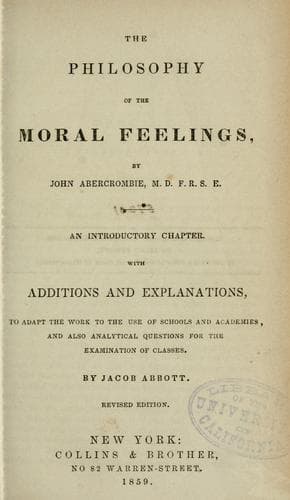
The Philosophy of the Moral FeelingsAbercrombie, John
Religion
The Philosophy of the Moral Feelings
Abercrombie, John
Ethics
When we withdraw our minds from the influence of sensible things, and
send forth our attention to those truths which are the province of
faith, the first great object which meets our view is the eternal
incomprehensible One, the moral governor of the universe,--a being of
infinite perfections and infinite purity. From the stupendous works of
nature, we trace his operation as the great First Cause,--and infer,
with absolute certainty, his boundless power and wisdom, and his
independent existence. The impress of his moral attributes he has fixed
with indelible certainty, upon our moral perceptions,--where, in the
light of conscience, co-operating with a simple process of reason, we
perceive him to be a being of infinite holiness, and of unerring truth
and justice. Our knowledge of these attributes is not the result of any
process of reasoning which can admit of deliberation or doubt. They
force themselves upon our conviction by the most simple principles of
induction, when, from our own mental and moral endowments, we infer the
perfections of him who formed us.
From every conception we can form of such a being, we have an equally
insuperable conviction of his universal presence,--that he is the
witness not only of our conduct, but of the thoughts and imaginations
of the heart;--and that from these, as indicating our real condition,
and not from our conduct alone, our moral aspect is estimated by
him,--the pure and holy One who seeth in secret. Each moment, as it
passes rapidly over us, we know is bringing us nearer to that period,
when all our hopes and fears for this world shall lie with us in the
grave. But we feel also that this is the entrance to another state of
being,--a state of moral retribution, where the eternal One is to be
disclosed in all his attributes as a moral governor. These
considerations fix themselves upon the mind, with a feeling of yet new
and more tremendous interest, when we farther take into view that this
future existence stretches out before us into endless duration. This is
the truth so powerfully expressed by the sacred writer, in terms which
by their brevity convey, in the most adequate manner, their overwhelming
import,--"The things which are seen are temporal, but the things which
are not seen are eternal."
Public-domain text, read in full here on John Shaqi.
Reviews
Reviews
No reviews yet
Be the first to share your thoughts on this work.
Elsewhere in the archive
Join the Discussion
Join the discussion
Sign in to leave a comment or review.
Sign InorCreate an account