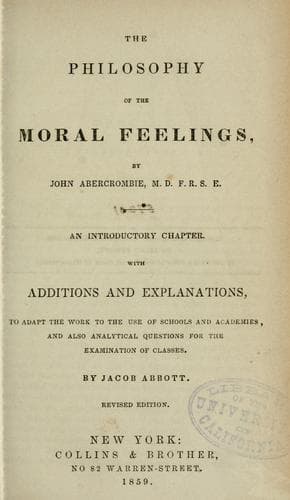
The Philosophy of the Moral FeelingsAbercrombie, John
Religion
The Philosophy of the Moral Feelings
Abercrombie, John
Ethics
In regard to the former, it is only necessary to remark, that the
revelation of Christian truth is not confined to an offer of pardon to
the guilty;--its great object is the recovery and purification of the
moral being; and there is an essential and inviolable union between
these two parts of the great scheme of redemption. It provides in the
most effectual manner for the interests of morality, by the
purification of the desires and affections, the springs of action;--it
is the morality of the heart. It proclaims a system of morals, more pure
and more exalted far than ever was contemplated by the wisest of
men;--it exhibits an example of the perfect state of a moral being, in
the character of the Messiah;--and it enforces the imitation of this
example as indispensable in every one who professes to be his disciple.
These different parts of the scheme can never be separated, and there
cannot be a greater perversion of reasoning, or a greater misconception
of the prominent features of the gospel of peace, than to allege that it
does not provide, in the most effectual manner, for the highest
interests of morality.
The other opinion is equally founded upon error,--namely, that which
considers it essential to faith, that a man be assured of his personal
acceptance in the sight of the Deity. It is obvious that this is a
sophism clearly opposed to sound reasoning, and to the first principles
of the philosophy of the moral feelings. For faith, viewed as a mental
process, must always have for its object facts; and these facts must
rest upon such evidence, as is sufficient to convince the understanding
of their truth. To talk of faith, without such facts and such evidence,
is a mere logical fallacy, or an absurdity in terms. But there is no
disclosure of the personal acceptance of any individual, and
consequently, on no principle of sound reasoning can this ever be
considered as the object of faith. This doctrine, therefore, applies a
most important principle of the mind, not to facts, which alone can
warrant the exercise of faith, but to a vision of the imagination, which
admits of no evidence, and cannot be subjected to any test of its truth.
Public-domain text, read in full here on John Shaqi.
Reviews
Reviews
No reviews yet
Be the first to share your thoughts on this work.
Elsewhere in the archive
Join the Discussion
Join the discussion
Sign in to leave a comment or review.
Sign InorCreate an account