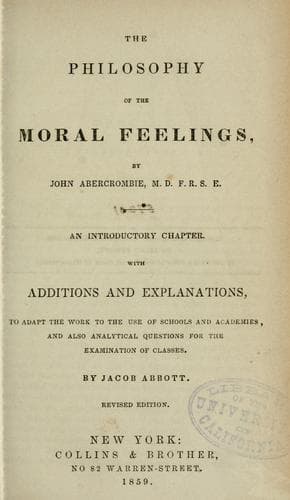
The Philosophy of the Moral FeelingsAbercrombie, John
Religion
The Philosophy of the Moral Feelings
Abercrombie, John
Ethics
Widely different from all such flimsy and imaginary hypotheses is the
great system of Christian truth,--harmonious and consistent in itself,
and challenging the approbation of the soundest understanding. It
reveals, as we have seen, a dispensation of mercy, in accordance with
the highest ideas we can form of the divine perfections. It is supported
by a chain of evidence, which carries conviction to the mind of the most
rigid inquirer; and thus it is a sound and legitimate object of faith.
It reveals also a provision for purifying the moral nature; and this in
every case accompanies the dispensation of mercy to those who receive
it. The effects of this powerful agency, therefore, become the test and
the evidence of the reality of faith. Does a man seek a proof of his
acceptance,--the reference is to facts in his own moral condition. He is
to look for it in a change which is taking place in his character,--a
new direction of his desires,--a new regulation of his affections,--a
habitual impression, to which he was a stranger before, of the presence
and the perfections of the Deity--and a new light which has burst upon
his view, respecting his relations to this life and to that which is to
come. He is to seek this evidence in a mind, which aims at no lower
standard than that which will bear the constant inspection of infinite
purity;--he is to seek it, and to manifest it to others, in a spirit
which takes no lower pattern than that model of perfection,--the
character of the Messiah. These acquirements, indeed, are looked upon,
not as a ground of acceptance, but a test of moral condition; not as, in
any degree, usurping the place of the great principle of faith, but as
its fruits and evidences. As these, then, are the only proofs of the
reality of this principle, so they are the only basis on which a man can
rest any sound conviction of his moral aspect in the sight of the
Deity;--and that system is founded on delusion and falsehood, which, in
this respect, holds out any other ground of confidence than the
purification of the heart, and a corresponding harmony of the whole
character. Such attainment, indeed, is not made at once, nor is it ever
made in a full and perfect manner in the present state of being; but,
where the great principle has been fixed within, there is a persevering
effort, and a uniform contest, and a continual aspiration after
conformity to the great model of perfection. Each step that a man gains
in this progress serves to extend his view of the high pattern to which
his eye is steadily directed; and, as his knowledge of it is thus
enlarged, he is led by comparison to feel more and more deeply his own
deficiency. It thus produces increasing humility, and an increasing
sense of his own imperfection, and causes him continually to feel, that,
in this warfare, he requires a power which is not in man. But he knows
also that this is provided, as an essential part of the great system on
which his hope is established.
Public-domain text, read in full here on John Shaqi.
Reviews
Reviews
No reviews yet
Be the first to share your thoughts on this work.
Elsewhere in the archive
Join the Discussion
Join the discussion
Sign in to leave a comment or review.
Sign InorCreate an account