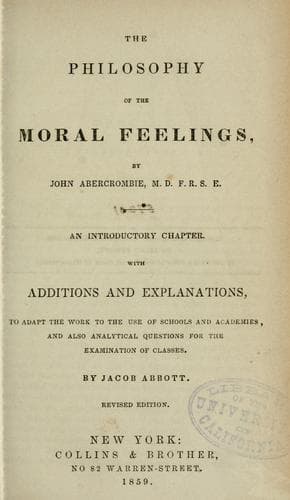
The Philosophy of the Moral FeelingsAbercrombie, John
Religion
The Philosophy of the Moral Feelings
Abercrombie, John
Ethics
VI. The Desire of Esteem and Approbation. This is a principle of most
extensive influence, and is in many instances the source of worthy and
useful displays of human character. Though inferior to the high sense of
moral obligation, it may yet be considered a laudable principle,--as
when a man seeks the approbation of others by deeds of benevolence,
public spirit, or patriotism,--by actions calculated to promote the
advantage or the comfort either of communities or individuals. In the
healthy exercise of it, a man desires the approbation of the good;--in
the distorted use of it, he seeks merely the praise of a party, or
perhaps, by deeds of a frivolous or even vicious character, aims at the
applause of associates whose praise is worthless. According to the
object to which it is directed, therefore, the desire of approbation may
be the attribute either of a virtuous or a perverted mind. But it is a
principle, which, in general, we expect to find operating in every
well-regulated mind, under certain restrictions. Thus a man who is
totally regardless of character,--that is, of the opinion of all others
respecting his conduct, we commonly consider as a person lost to correct
virtuous feeling. On the other hand, however, there may be instances in
which it is the quality of a man of the greatest mind to pursue some
course to which from adequate motives, he has devoted himself,
regardless alike of the praise or the disapprobation of other men. The
character in which the love of approbation is a ruling principle is
therefore modified by the direction of it. To desire the approbation of
the virtuous, leads to conduct of a corresponding kind, and to
steadiness and consistency in such conduct. To seek the approbation of
the vicious, leads, of course, to an opposite character. But there is a
third modification, presenting a subject of some interest, in which the
prevailing principle of the man is a general love of approbation,
without any discrimination of the characters of those whose praise is
sought, or of the value of the qualities on account of which he seeks
it. This is vanity; and it produces a conduct wavering and
inconsistent,--perpetually changing with the circumstances in which the
individual is placed. It often leads him to aim at admiration for
distinctions of a very trivial character,--or even for qualities which
he does not really possess. It thus includes the love of flattery.
Pride, on the other hand, as opposed to vanity, seems to consist in a
man entertaining a high opinion of himself, while he is indifferent to
the opinion of others;--thus we speak of a man who is too proud to be
vain.
Public-domain text, read in full here on John Shaqi.
Reviews
Reviews
No reviews yet
Be the first to share your thoughts on this work.
Join the Discussion
Join the discussion
Sign in to leave a comment or review.
Sign InorCreate an account