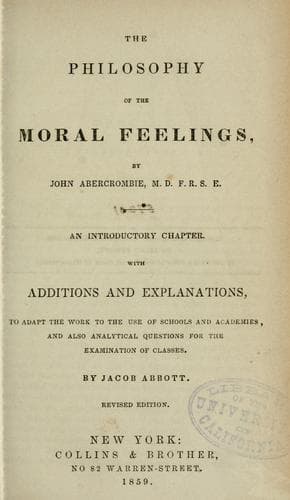
The Philosophy of the Moral FeelingsAbercrombie, John
Religion
The Philosophy of the Moral Feelings
Abercrombie, John
Ethics
VII. The Desire of Knowledge, or of Intellectual Improvement,--including
the principle of Curiosity. The tendency of this high principle must
depend, as in the former cases, on its regulation, and the objects to
which it is directed. These may vary from the idle tattle of the day, to
the highest attainments in literature or science. The principle may be
applied to pursuits of a frivolous or useless kind, and to such
acquirements as lead only to pedantry or sophism;--or it may be directed
to a desultory application, which leads to a superficial acquaintance
with a variety of subjects, without a correct knowledge of any of them.
On the other hand, the pursuit of knowledge may be allowed to interfere
with important duties which we owe to others, in the particular
situation in which we are placed. A well-regulated judgment conducts
the propensity to worthy objects; and directs it in such a manner as to
make it most useful to others. With such due regulation, the principle
ought to be carefully cultivated in the young. It is closely connected
with that activity of mind which seeks for knowledge on every subject
that comes within its reach, and which is ever on the watch to make its
knowledge more correct and more extensive.
VIII. The Desire of Moral Improvement. This leads to the highest state
of man: and it bears this peculiar character, that it is adapted to men
in every scale of society, and tends to diffuse a beneficial influence
around the circle with which the individual is connected. The desire of
power may exist in many, but its gratification is limited to a few:--he
who fails may become a discontented misanthrope; and he who succeeds may
be a scourge to his species. The desire of superiority or of praise may
be misdirected in the same manner, leading to insolent triumph on the
one hand, and envy on the other. Even the thirst for knowledge may be
abused, and many are placed in circumstances in which it cannot be
gratified. But the desire of moral improvement commends itself to every
class of society, and its object is attainable by all. In proportion to
its intensity and its steadiness, it tends to make the possessor both a
happier and a better man, and to render him the instrument of diffusing
happiness and usefulness to all who come within the reach of his
influence. If he be in a superior station, these results will be felt
more extensively; if he be in a humble sphere, they may be more limited;
but their nature is the same, and their tendency is equally to elevate
the character of man. This mental condition consists, as we shall
afterwards have occasion to shew more particularly, in a habitual
recognition of the supreme authority of conscience over the whole
intellectual and moral system, and in a habitual effort to have every
desire and every affection regulated by the moral principle, and by a
sense of the divine will. It leads to a uniformity of character which
can never flow from any lower source, and to a conduct distinguished by
Public-domain text, read in full here on John Shaqi.
Reviews
Reviews
No reviews yet
Be the first to share your thoughts on this work.
Join the Discussion
Join the discussion
Sign in to leave a comment or review.
Sign InorCreate an account