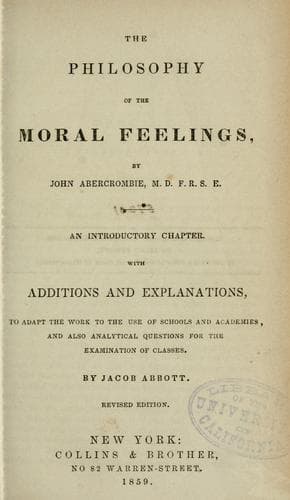
The Philosophy of the Moral FeelingsAbercrombie, John
Religion
The Philosophy of the Moral Feelings
Abercrombie, John
Ethics
In concluding the whole subject of the affections, I have only farther
to remark,--that the regulated state of the moral feelings, which has
been the subject of the preceding observations, seems to correspond with
the quality so emphatically described in the sacred writings under the
name of Charity. It is there uniformly represented as the great test of
the moral condition; and we find exposed, in the most striking manner,
the worthlessness of all endowments which are not accompanied by this
regulation of the whole character. We cannot, therefore, conclude this
subject in a more appropriate manner, than by a passage in which, by a
few most powerful expressions, a code of ethical science is laid before
us with a clearness and a force, which put to nought all human
composition:--"Though I speak with the tongues of men and of angels, and
have not charity, I am become as sounding brass, or a tinkling cymbal.
And though I have the gift of prophecy, and understand all mysteries,
and all knowledge; and though I have all faith, so that I could remove
mountains, and have not charity, I am nothing. And though I bestow all
my goods to feed the poor, and though I give my body to be burned, and
have not charity, it profiteth me nothing. Charity suffereth long, and
is kind; charity envieth not; charity vaunteth not itself, is not puffed
up, doth not behave itself unseemly, seeketh not her own, is not easily
provoked, thinketh no evil; rejoiceth not in iniquity, but rejoiceth in
the truth; beareth all things, believeth all things, hopeth all things,
endureth all things. Charity never faileth; but whether there be
prophecies, they shall fail; whether there be tongues, they shall cease;
whether there be knowledge, it shall vanish away. For we know in part,
and we prophecy in part. But when that which is perfect is come, then
that which is in part shall be done away. When I was a child, I spake as
a child, I understood as a child, I thought as a child: but when I
became a man, I put away childish things. For now we see through a
glass, darkly; but then face to face; now I know in part; but then shall
I know even as also I am known. And now abideth faith, hope, charity,
these three,--but the greatest of these is charity."
SECT. III.
SELF-LOVE.
Public-domain text, read in full here on John Shaqi.
Reviews
Reviews
No reviews yet
Be the first to share your thoughts on this work.
Elsewhere in the archive
Join the Discussion
Join the discussion
Sign in to leave a comment or review.
Sign InorCreate an account