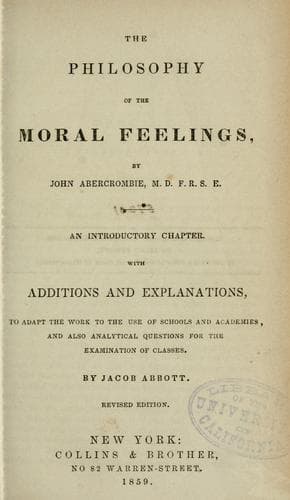
The Philosophy of the Moral FeelingsAbercrombie, John
Religion
The Philosophy of the Moral Feelings
Abercrombie, John
Ethics
There has been some dispute respecting the term Self-love, both as to
its general propriety, and as to the mental feelings which ought to be
referred to it. There can be no doubt that there is, in our
constitution, a principle or propensity which leads us to study our own
interest, gratification, and comfort; and that, in many instances, it
becomes the ruling principle of the character. It is in this sense that
I use the term self-love, without entering into any discussion regarding
the strict logical propriety of it. Like the other mental feelings, it
is to be considered as part of our moral constitution, and calculated to
answer important purposes, provided it be kept in its proper place, and
do not encroach upon the duties and affections which we owe to other
men. When thus regulated, it constitutes prudence, or a just regard to
our own interest, safety, and happiness; when it becomes morbid in its
exercise, it degenerates into selfishness.
A sound and rational self-love ought to lead us to seek our own true
happiness, and should prove a check upon those appetites and passions
which interfere with this; for many of them, it must be allowed, may be
not less adverse to our own real interest and comfort, than they are to
our duty to other men. It should lead us, therefore, to avoid every
thing, not only that is opposed to our interest, but that is calculated
to impair our peace of mind, and that harmony of the moral feelings
without which there can be no real happiness. This includes a due
regulation of the desires, and a due exercise of the affections, as a
moral condition which promotes our own welfare and comfort. Self-love,
viewed in this manner, appears to be placed as a regulating principle
among the other powers,--much inferior indeed to the great principle of
conscience, so far as regards the moral condition of the
individual,--but calculated to answer important purposes in promoting
the harmonies of society. The impression, on which its influence rests,
appears to be simply the comfort and satisfaction which arise to
ourselves from a certain regulation of the desires, and a certain
exercise of the affections, while feelings of an opposite kind follow a
different conduct. These sources of satisfaction are manifold. We may
reckon among them the pleasure attached to the exercise of the
affections themselves, a feature of our moral constitution of the most
interesting kind,--the true mental peace and enjoyment which spring
from benevolence, friendship, meekness, forgiveness, and the whole
train of the kindly feelings,--the gratitude of those who have
experienced the effects of our kindness,--the respect and approbation of
those whose esteem we feel to be valuable,--and the return of similar
affections and good offices from other men. On the other hand, we have
to keep in mind the mental agony and distraction which arise from
jealousy, envy, hatred, and resentment,--the sense of shame and disgrace
Public-domain text, read in full here on John Shaqi.
Reviews
Reviews
No reviews yet
Be the first to share your thoughts on this work.
Elsewhere in the archive
Join the Discussion
Join the discussion
Sign in to leave a comment or review.
Sign InorCreate an account