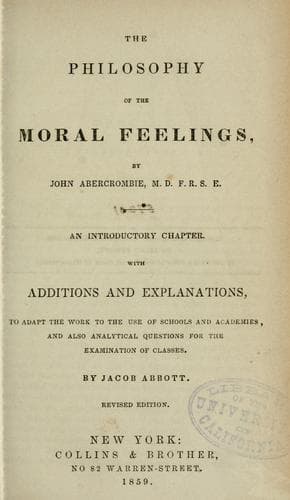
The Philosophy of the Moral FeelingsAbercrombie, John
Religion
The Philosophy of the Moral Feelings
Abercrombie, John
Ethics
NATURE AND IMPORTANCE OF THE SCIENCE OF THE MORAL FEELINGS.
Man is to be contemplated as an intellectual, and as a moral being. By
his intellectual powers, he acquires the knowledge of facts, observes
their connexions, and traces the conclusions which arise out of them.
These mental operations, however, even in a high state of cultivation,
may be directed entirely to truths of an extrinsic kind,--that is, to
such as do not exert any influence either on the moral condition of the
individual, or on his relations to other sentient beings. They may exist
in an eminent degree in the man who lives only for himself, and feels
little beyond the personal wants, or the selfish enjoyments of the hour
that is passing over him.
But, when we contemplate man as a moral being, new relations open on our
view, and these are of mightier import. We find him occupying a place in
a great system of moral government, in which he has an important station
to fill and high duties to perform. We find him placed in certain
relations to a great moral Governor, who presides over this system of
things, and to a future state of being for which the present scene is
intended to prepare him. We find him possessed of powers which qualify
him to feel these relations, and of principles calculated to guide him
through the solemn responsibilities which attend his state of moral
discipline.
These two parts of his mental constitution we perceive to be remarkably
distinct from each other. The former may be in vigorous exercise in him
who has little feeling of his moral condition,--and the latter may be in
a high state of culture in the man, who, in point of intellectual
acquirement, knows little beyond the truths which it most concerns him
to know,--those great but simple principles which guide his conduct as
a responsible being.
In a well-regulated mind, there is an intimate harmony and co-operation
between these two departments of the mental economy. Knowledge, received
through the powers of sensation and simple intellect, whether relating
to external things, or to mental phenomena,--and conclusions derived
from these through the powers of reasoning, ought all to contribute to
that which is the highest state of man,--his purity as a moral being.
They ought all to lend their aid towards the cultivation of those
principles of his nature which bind him to his fellow-men;--and those
higher principles still, which raise his feeble powers to the Eternal
Incomprehensible One, the first great cause of all things, and the moral
Governor of the universe.
Public-domain text, read in full here on John Shaqi.
Reviews
Reviews
No reviews yet
Be the first to share your thoughts on this work.
Join the Discussion
Join the discussion
Sign in to leave a comment or review.
Sign InorCreate an account