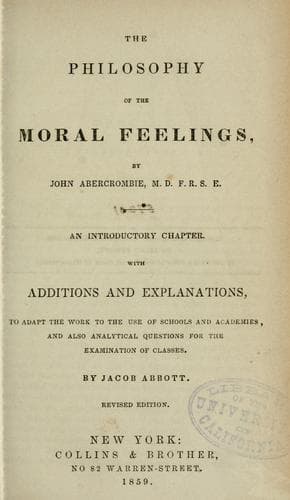
The Philosophy of the Moral FeelingsAbercrombie, John
Religion
The Philosophy of the Moral Feelings
Abercrombie, John
Ethics
them, and provided he is in that moral condition which is required for
their efficiency.
In all such cases, which are familiar to every one, we recognise,
therefore, a uniform relation between certain moral causes or motives,
and the determinations of the human mind in willing certain acts. It is
no objection to this, that men act in very different ways with the same
motives before them;--for this depends upon their own moral condition.
When treating of the intellectual powers, I alluded to the metaphysical
controversies connected with this subject, and I do not mean to recur to
them here. Our present object is entirely of a practical
nature,--namely, to investigate the circumstances which are required for
the due operation of motives or moral causes, and the manner in which
the moral feelings may be so deranged, that these fail of producing
their natural or proper effects.
* * * * *
Let us, then, suppose an individual deliberating in regard to the line
of conduct he shall pursue in a particular case;--the circumstances or
impressions which are calculated to act upon him as moral causes in
determining his volition,--that is, in deciding his conduct, are
chiefly the following: (1.) Self-love, which prompts him to seek his own
ease, interest, or gratification. (2.) Certain affections which lead him
to take into view duties which he owes to other men; such as, justice,
benevolence, &c. (3.) The impression of moral rectitude or moral
responsibility. This is derived from the great principle of conscience,
aided by the truths of religious belief. (4.) We ought to add reason of
judgment, which leads him to perceive certain tendencies of actions,
apart from their moral aspect. Now, in deciding on his conduct in any
particular instance, one man makes every thing bend to his own interest
or pleasure,--with little regard to the interests of others;--unless in
so far as the absolute requirements of justice are concerned, the
infringement of which might expose him to loss of reputation, or even to
punishment.--Another surrenders a certain portion of his personal
gratification to the advantage or comfort of others, purely as an
exercise of feeling from which he experiences satisfaction;--influenced,
also, probably, in some measure, by a regard to character, or the love
of approbation. In such a man, it becomes, in individual instances, a
matter of calculation, what degree of the sacrifice of personal ease,
interest, of feeling, is to be made to this principle of action. A third
contemplates the case purely as one of duty of moral responsibility, and
acts upon this principle, though it may involve a degree of personal
exertion, or a sacrifice of personal feeling, in itself disagreeable or
even injurious to him; that is, though the strongest personal motives
would lead to a different conduct. Let the case, again, refer to one of
the desires, bearing no immediate relation to the interests of other
men.
Public-domain text, read in full here on John Shaqi.
Reviews
Reviews
No reviews yet
Be the first to share your thoughts on this work.
Elsewhere in the archive
Join the Discussion
Join the discussion
Sign in to leave a comment or review.
Sign InorCreate an account