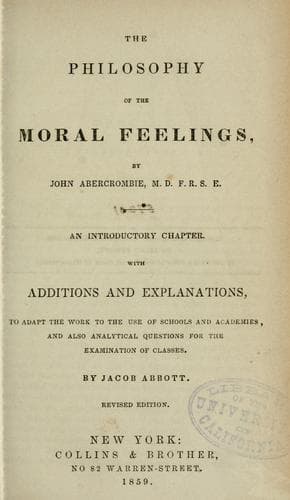
The Philosophy of the Moral FeelingsAbercrombie, John
Religion
The Philosophy of the Moral Feelings
Abercrombie, John
Ethics
One man goes directly into the gratification of it, without any
consideration. Another, who feels the same desire, considers the
influence which the indulgence would be likely to have on his health,
interest, or reputation.--This may be considered as simply an exercise
of judgment, combined with a certain operation of self-love. A third
views the aspect of the deed purely as a question of moral
responsibility,--and, if he sees cause, decides against it on this
ground alone;--though he should perceive that it might be gratified
without any danger to his health, interest, or reputation, or even that
it might contribute to his advantage.
We have thus presented to us three characters;--one who acts upon the
high and pure ground of moral principle;--one who acts from motives of a
more contracted and personal nature, though, in certain instances, his
conduct may be the same;--and one who goes straight forward to the
gratification of a ruling desire or governing propensity, without
attending to motives of either class. The first is a uniform character,
on whose conduct we depend in any given circumstances, with a confidence
similar to that with which we rely on the operation of physical agents.
For we know the uniform tendencies of the motives or moral causes by
which he is habitually influenced, and we know his moral temperament. We
have nearly the same kind of knowledge respecting him, which we have of
the tendencies of chemical agents towards each other, and which enables
us with perfect confidence to foretel their actions. The third has also
a uniformity of conduct, though of a very different kind. We know,
likewise, his moral condition, and, to predict his conduct, we require
only to learn the particular inducements or temptations to which he is
exposed in a given instance. The second we cannot rely or calculate
upon; for we have not the means of tracing the conflicting views by
which he may be influenced in a particular case, or the principle on
which he may ultimately decide between them. They involve the strength
of the inclination,--and the degree of power exerted over it by the
class of personal or selfish motives by which he is influenced.--In
regard to various instances of ill-regulated desire, we must add his
hope of evading detection,--as on this depends, in a great measure, the
kind of evils dreaded by him in reference to the indulgence. These taken
together imply a complicated moral calculation, of which it is
impossible for another man to trace the result.
There cannot be an inquiry of more intense interest than to investigate
the causes in which originate the differences among these three
characters; or, in other words, the principles on which we can explain
the fact, that the will of individuals may be influenced so differently
with the same motives before them. These appear to be referable to
three heads,--Knowledge,--Attention,--and Moral Habits.
Public-domain text, read in full here on John Shaqi.
Reviews
Reviews
No reviews yet
Be the first to share your thoughts on this work.
Elsewhere in the archive
Join the Discussion
Join the discussion
Sign in to leave a comment or review.
Sign InorCreate an account