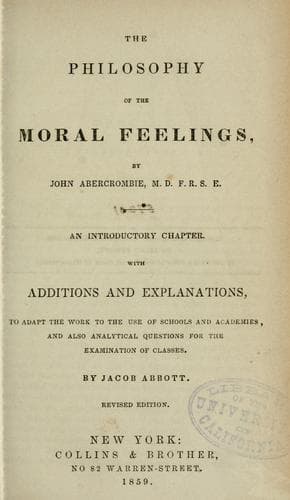
The Philosophy of the Moral FeelingsAbercrombie, John
Religion
The Philosophy of the Moral Feelings
Abercrombie, John
Ethics
Their power as moral causes is gone, and
even the judgment is altered respecting their moral tendencies. He views
them now perhaps as the superstitions of the vulgar, or the prejudices
of a contracted education; and rejoices, it may be, in his emancipation
from their authority. He knows not,--for he has not the moral perception
now to know, that he has been pursuing a downward course, and that the
issue, on which he congratulates himself, consists in his last
degradation as a moral being. Even in this state of moral destitution,
indeed, the same warning principle may still raise its voice,--unheeded
but not subdued,--repelled as an enemy, not admitted as a friendly
monitor and guide. "I have not the smallest influence over Lord Byron,
in this particular," writes one of the chosen friends of that
distinguished individual,--"if I had, I certainly should employ it to
eradicate from his great mind the delusions of Christianity, which, in
spite of his reason, seem perpetually to recur, and to lay in ambush for
the hours of sickness and distress." It would be interesting to know
what the particular impressions were, from which this sympathizing
friend was anxious to rescue the poet. They were probably the
suggestions of a power within, which, in certain seasons of reflection,
compelled his attention in spite of his attempts to reason against
it,--pleading with authority for a present Deity, and a life to come.
The principle of Habit, therefore, holds a most important place in the
moral condition of every man; and it applies equally to any species of
conduct, or any train of mental operations, which, by frequent
repetition, have become so familiar, as not to be accompanied by a
recognition of the principles in which they originated. In this manner
good habits are continued without any immediate sense of the right
principles by which they were formed; but they arose from a frequent
and uniform acting upon these principles, and on this is founded the
moral approbation which we attach to habits of this description. In the
same manner, habits of vice, and habits of inattention to any class of
duties, are perpetuated without a sense of the principles and affections
which they violate; but this arose from a frequent violation of these
principles, and a frequent repulsion of these affections, until they
gradually lost their power over the conduct; and in this consists the
guilt of habits. Thus, one person acquires habits of benevolence,
veracity, and kindness,--of minute attention to his various duties,--of
correct mental discipline,--and active direction of his thoughts to all
those objects of attention which ought to engage a well regulated
mind:--Another sinks into habits of listless vacuity or frivolity of
mind,--of vicious indulgence and contracted selfishness,--of neglect of
important duties, disregard to the feelings of others, and total
indifference to all those considerations and pursuits which claim the
Public-domain text, read in full here on John Shaqi.
Reviews
Reviews
No reviews yet
Be the first to share your thoughts on this work.
Elsewhere in the archive
Join the Discussion
Join the discussion
Sign in to leave a comment or review.
Sign InorCreate an account