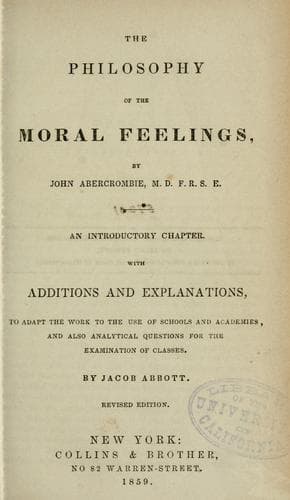
The Philosophy of the Moral FeelingsAbercrombie, John
Religion
The Philosophy of the Moral Feelings
Abercrombie, John
Ethics
over the volitions or determinations of the mind, and, at a certain
period of this progress, the judgment itself comes to be changed
respecting the moral aspect of the deed.
There is still another mental condition to be mentioned in connexion
with this subject; in which the harmony of the moral feelings may be
destroyed, without the action following. This takes places when the
inclination is cherished, as in the former case, in opposition to the
indications of conscience; while the action is opposed by some inferior
motives,--as a regard to reputation or interest. The deed may thus be
prevented, and the interests of society may benefit by the difference;
but, so far as regards the individual himself, the disruption of moral
harmony is the same; and his moral aspect must be similar in the eye of
the Almighty One, who regards not the outward appearance alone, but who
looketh into the heart. In this manner it may very often happen, that
strong inducements to vice are resisted from motives referring merely to
health, or to character. But this is not to overcome temptation,--it is
only to balance one selfish feeling against another.
III. From the state of mind which has now been referred to, there
gradually results a _Moral Habit_. This is a mental condition, in which
a desire or an affection, repeatedly acted upon, is, after each
repetition, acted upon with less and less effort,--and, on the other
hand, a truth or moral principle, which has been repeatedly passed over
without adequate attention, after every such act makes less and less
impression, until at length it ceases to exert any influence over the
moral feelings or the conduct. I had occasion to illustrate this
remarkable principle in another point of view, when treating of the
connexion between the emotions of sympathy and benevolence, and the
conduct which naturally arises out of them. This conduct at first may
require a certain effort, and is accompanied by a strong feeling of the
emotion which leads to it. But, after each repetition, the acts go on
with less feeling of the emotion, and less reference to the principle
from which they spring, while there is progressively forming the habit
of active benevolence. It is precisely the same with habits of vice. At
first a deed requires an effort,--and a powerful contest with moral
principles, and it is speedily followed by that feeling of regret, to
which superficial observers give the name of repentance. This is the
voice of conscience, but its power is more and more diminished after
each repetition of the deed;--even the judgment becomes perverted
respecting the first great principles of moral rectitude; and acts,
which at first occasioned a violent conflict, are gone into without
remorse, or almost without perception of their moral aspect. A man in
this situation may still retain the knowledge of truths and principles
which at one time exerted an influence over his conduct; but they are
now matters of memory alone.
Public-domain text, read in full here on John Shaqi.
Reviews
Reviews
No reviews yet
Be the first to share your thoughts on this work.
Elsewhere in the archive
Join the Discussion
Join the discussion
Sign in to leave a comment or review.
Sign InorCreate an account