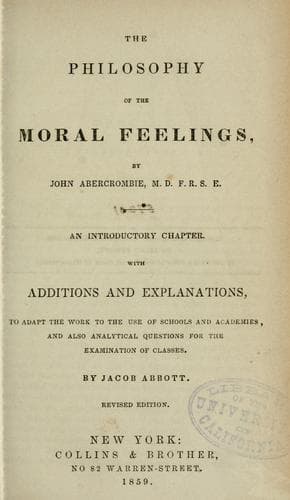
The Philosophy of the Moral FeelingsAbercrombie, John
Religion
The Philosophy of the Moral Feelings
Abercrombie, John
Ethics
that, for producing it, nothing will avail but an influence from without
the mind,--a might and a power from the same Almighty One who originally
framed it. Philosophy teaches, in the clearest manner, that a portion of
mankind require such a transformation; Christianity informs us that it
is required by all. When the inductions of science and the dictates of
revelation harmonize to this extent, who shall dare to assert that the
latter are not truth. Who, that places himself in the presence of a
being of infinite purity, will say, he requires not such a change; or
that, for the production of it, he needs no agency, beyond the resources
of his own mind. If none be found who is entitled to believe he forms
the exception, we are forced into the acknowledgement of the truth, so
powerfully impressed upon us in the sacred writings, that, in the eye of
the Almighty One, no man in himself is righteous; and that his own power
avails not for restoring him to a state of moral purity.
From the whole of this inquiry, we see the deep influence of habits, and
the fearful power which they may acquire over the whole moral system;
considerations of the highest practical interest to those who would
prevent the formation of habits of an injurious nature, or who, feeling
their influence, strive to be delivered from them. There is indeed a
point in this downward course, where the habit has acquired undisputed
power, and the whole moral feelings yield to it unresisting submission.
Peace may then be within, but that peace is the stillness of death; and,
unless a voice from heaven shall wake the dead, the moral being is lost.
But, in the progress towards this fearful issue, there maybe a tumult,
and a contest, and a strife, and the voice of conscience may still
command a certain attention to its warnings. While there are these
indications of life, there is yet hope of the man; but on each moment is
now suspended his moral existence. Let him retire from the influence of
external things; and listen to that voice within, which, though often
unheeded, still pleads for God. Let him call to aid those high truths
which relate to the presence and inspection of this being of infinite
purity, and the solemnities of a life which is to come. Above all, let
him look up in humble supplication to that pure and holy One, who is the
witness of this warfare,--who will regard it with compassion, and impart
his powerful aid. But let him not presumptuously rely on this aid, as if
the victory were already secured. The contest is but begun; and there
must be a continued effort, and unceasing watchfulness,--a habitual
direction of the attention to those truths which, as moral causes, are
calculated to act upon the mind,--and a constant reliance upon the power
from on high which is felt to be real and indispensable. With all this
provision, his progress may be slow; for the opposing principle, and the
influence of established moral habits, may be felt contending for their
Public-domain text, read in full here on John Shaqi.
Reviews
Reviews
No reviews yet
Be the first to share your thoughts on this work.
Elsewhere in the archive
Join the Discussion
Join the discussion
Sign in to leave a comment or review.
Sign InorCreate an account