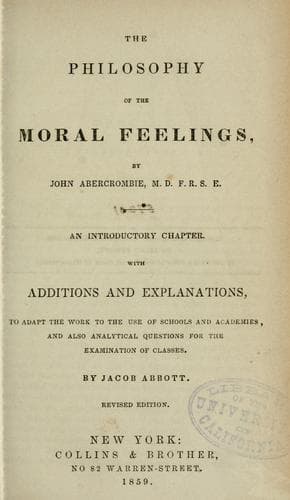
The Philosophy of the Moral FeelingsAbercrombie, John
Religion
The Philosophy of the Moral Feelings
Abercrombie, John
Ethics
former dominion; but by each advantage that is achieved over them, their
power will be broken, and finally destroyed. Now in all this contest
towards the purity of the moral being, each step is no less a process of
the mind itself than the downward course by which it was preceded. It
consists in a surrender of the will to the suggestions of conscience,
and a habitual direction of the attention to those truths which are
calculated to act upon the moral volitions. In this course, the man
feels that he is authorized to look for a might and an influence not his
own. This is no imaginary or mysterious impression, which one may fancy
that he feels, and then pass on contented with the vision; but a power
which acts through the healthy operations of his own mind; it is in his
own earnest exertions, as a rational being, to regulate these
operations, that he is encouraged to expect its communication; and it is
in feeling these assuming the characters of moral health, that he has
the proof of its actual presence.
And where is the improbability that the pure and holy One, who framed
the wondrous moral being, may thus hold intercourse with it, and impart
an influence in its hour of deepest need. According to the utmost of our
conceptions, it is the highest of his works,--for he has endowed it with
the power of rising to the contemplation of himself, and with the
capacity of aspiring to the imitation of his own moral perfections. We
cannot, for a moment, doubt, that his eye must reach its inmost
movements, and that all its emotions, and desires, and volitions, are
exposed to his view. We must believe that he looks with displeasure when
he perceives them wandering from himself; and contemplates with
approbation the contest, when the spirit strives to throw off its moral
bondage, and to fight its way upwards to a conformity to his will. Upon
every principle of sound philosophy, all this must be open to his
inspection; and we can perceive nothing opposed to the soundest
inductions of reason in the belief, that he should impart an influence
to the feeble being in this high design, and conduct him to its
accomplishment. In all this, in fact, there is so little improbability,
that we find it impossible to suppose it could be otherwise. We find it
impossible to believe, that such a mental process could go on without
the knowledge of him whose presence is in every place,--or that, looking
upon it, he should want either the power or the willingness to impart
his effectual aid.
Public-domain text, read in full here on John Shaqi.
Reviews
Reviews
No reviews yet
Be the first to share your thoughts on this work.
Elsewhere in the archive
Join the Discussion
Join the discussion
Sign in to leave a comment or review.
Sign InorCreate an account