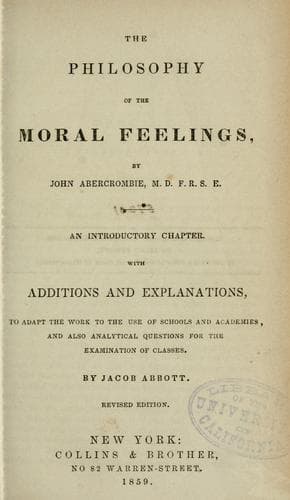
The Philosophy of the Moral FeelingsAbercrombie, John
Religion
The Philosophy of the Moral Feelings
Abercrombie, John
Ethics
the interposition of that incomprehensible One, whose eye is upon all
his works.
PART III.
OF THE MORAL PRINCIPLE, OR CONSCIENCE.
There has been much dispute respecting the nature and even the existence
of the Moral Principle, as a distinct element of our mental
constitution; but this controversy may probably be considered as allied
to other speculations of a metaphysical nature, in regard to which a
kind of evidence was sought of which the subjects are not susceptible.
Without arguing respecting the propriety of speaking of a separate power
or principle, we simply contend for the fact, that there is a mental
exercise, by which we _feel_ certain actions to be right and certain
others wrong. It is an element or a movement of our moral nature which
admits of no analysis, and no explanation; and is referable to no other
principle than a simple recognition of the fact, which forces itself
upon the conviction of every man who looks into the processes of his own
mind. Of the existence and the nature of this most important principle,
therefore, the evidence is entirely within. We appeal to the
consciousness of every man, that he perceives a power which, in
particular cases, warns him of the conduct which he ought to pursue, and
administers a solemn admonition when he has departed from it. For, while
his judgment conveys to him an impression, both of the tendencies and
certain of the qualities of actions, he has, besides this, a feeling
by which he views the actions with approbation or disapprobation,
in reference purely to their moral aspect, and without any regard
to their consequences. When we refer to the sacred writings, we
find the principle of conscience represented as a power of such
importance,--that, without any acquired knowledge, or any actual
precepts, it is sufficient to establish, in every man, such an
impression of his duty as leaves him without excuse in the neglect of
it:--"For when the Gentiles, which have not the law, do by nature the
things contained in the law, these, having not the law, are a law unto
themselves; which shew the work of the law written in their hearts, then
conscience also bearing witness, and their thoughts the meanwhile
accusing or else excusing one another." We even find a power assigned to
the decisions of conscience, differing in extent only, but not in kind,
from the judgment of the Almighty;--"If our heart condemn us, God is
greater than our heart, and knoweth all things."
Public-domain text, read in full here on John Shaqi.
Reviews
Reviews
No reviews yet
Be the first to share your thoughts on this work.
Elsewhere in the archive
Join the Discussion
Join the discussion
Sign in to leave a comment or review.
Sign InorCreate an account