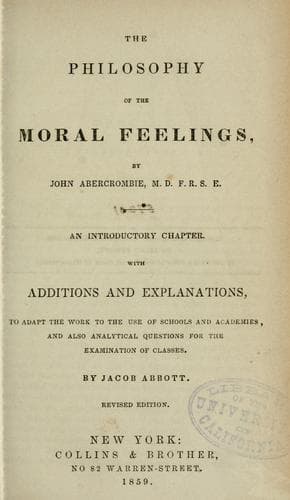
The Philosophy of the Moral FeelingsAbercrombie, John
Religion
The Philosophy of the Moral Feelings
Abercrombie, John
Ethics
But, independently of our conviction of an actual communication from the
Deity, there is a power in the mind itself, which is calculated to draw
down upon it an influence of the most efficient kind. This is produced
by the mental process which we call Faith: and it may be illustrated by
an impression which many must have experienced. Let us suppose that we
have a friend of exalted intelligence and virtue, who has often
exercised over us a commanding influence,--restraining us from pursuits
to which we felt an inclination,--exciting us to virtuous conduct,--and
elevating, by his intercourse with us, our impressions of a character on
which we wished to form our own. Let us suppose that we are removed to a
distance from this friend, and that circumstances of difficulty or
danger occur, in which we feel the want of a guide and counsellor. In
the reflections which the situation naturally gives rise to, the image
of our friend is brought before us; an influence is conveyed analogous
to that which was often produced by his presence and his counsel;--and
we feel as if he were actually present, to tender his advice and watch
our conduct. How much would this impression be increased, could we
farther entertain the thought, that this absent friend was able, in some
way, to communicate with us, so far as to be aware of our present
circumstances, and to perceive our efforts to recall the influence of
his character upon our own.--Such is the intercourse of the soul with
God.--Every movement of the mind is known to him; his eye is present
with it, when, in any situation of duty, distress, or mental discipline,
the man, under this exercise of faith, realizes the presence and
character of the Deity, and solemnly inquires how, in the particular
instance, his moral feelings and his conduct will appear in the eye of
him who seeth in secret. This is no vision of the imagination, but a
fact supported by every principle of sound reason,--the influence which
a man brings down upon himself, when, by an effort of his own mind, he
thus places himself in the immediate presence of the Almighty. The man
who does so in every decision of life is he who lives by faith;--and,
whether we regard the inductions of reason, or the dictates of sacred
truth, such a man is taught to expect an influence greater and more
effectual still. This is a power immediately from God, which shall be to
him direction in every doubt,--light in every darkness,--strength in his
utmost weakness,--and comfort in all distress;--a power which shall bear
upon all the principles of his moral nature, when he carries on the
mighty conflict of bringing every desire and every volition under a
conformity to the divine will. We again hazard with confidence the
assertion, that in all this there is no improbability;--but that, on the
contrary, the improbability is entirely on the other side,--in supposing
that any such mental process could take place, without the knowledge and
Public-domain text, read in full here on John Shaqi.
Reviews
Reviews
No reviews yet
Be the first to share your thoughts on this work.
Elsewhere in the archive
Join the Discussion
Join the discussion
Sign in to leave a comment or review.
Sign InorCreate an account