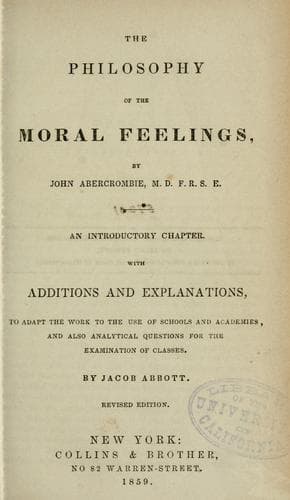
The Philosophy of the Moral FeelingsAbercrombie, John
Religion
The Philosophy of the Moral Feelings
Abercrombie, John
Ethics
In all this process there is a striking analogy to certain conditions of
the moral feelings, and to the control which is exercised over them by
the principle of Conscience. By self-love, a man is led to seek his own
gratification or advantage;--and the desires direct him to certain
objects by which these propensities may be gratified. But the affections
carry forth his views to other men with whom he is connected by various
relations, and to the offices of justice, veracity, and benevolence,
which arise out of them. Conscience is the regulating power, which,
acting upon the desires and affections, as reason does upon a series of
facts, preserves among them harmony and order. It does so by repressing
the propensity of selfishness, and reminding the man of the true
relation between regard to his own interest and the duties he owes to
other men. It regulates his senses and pursuits, by carrying his views
beyond present feelings and present gratifications, to future times and
future consequences,--and by raising his attention to his relation to
the great moral Governor of the universe. He thus learns to adapt his
conduct and pursuits, not to present and transient feelings, but to an
extended view of his great and true interests as a moral being. Such is
conscience,--still, like reason, pointing out the moral ends a man ought
to pursue, and guiding him in the means by which he ought to pursue
them;--and the man does not act in conformity with the constitution of
his nature, who does not yield to conscience the supremacy and direction
over all his other feelings and principles of action. But the analogy
does not stop here;--for we can also trace a condition in which this
controlling influence of conscience is suspended or lost. I formerly
endeavoured to trace the manner in which this derangement arises, and
have now only to allude to its influence on the harmony of the moral
feelings. Self-love degenerates into low selfish gratification: the
desires are indulged without any other restraint than that which arises
from a mere selfish principle,--as a regard to health, perhaps in some
degree to reputation; the affections are exercised only in so far as
similar principles impose a certain degree of attention to them: present
and momentary impulses are acted upon, without any regard to future
results: conduct is adapted to present gratification, without the
perception either of its moral aspect, or its consequences to the man
himself as a responsible being; and without regard to the means by which
these feelings are gratified. In all this violation of moral harmony,
there is no derangement of the ordinary exercise of judgment. In the
most remarkable example that can be furnished by the history of human
depravity, the man may be as acute as ever in the details of business or
the pursuits of science. There is no diminution of his sound estimate
of physical relations,--for this is the province of reason. But there is
Public-domain text, read in full here on John Shaqi.
Reviews
Reviews
No reviews yet
Be the first to share your thoughts on this work.
Elsewhere in the archive
Join the Discussion
Join the discussion
Sign in to leave a comment or review.
Sign InorCreate an account