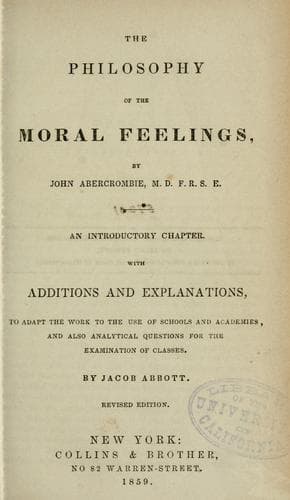
The Philosophy of the Moral FeelingsAbercrombie, John
Religion
The Philosophy of the Moral Feelings
Abercrombie, John
Ethics
a total derangement of his sense and approbation of moral
relations,--for this is conscience. Such a condition of mind, then,
appears to be, in reference to the moral feelings, what insanity is in
regard to the intellectual. The intellectual maniac fancies himself a
king, surrounded by every form of earthly splendour,--and this
hallucination is not corrected even by the sight of his bed of straw and
all the horrors of his cell. The moral maniac pursues his way, and
thinks himself a wise and a happy man:--- but feels not that he is
treading a downward course, and is lost as a moral being.
* * * * *
In the preceding observations respecting the moral principle or
conscience, I have alluded chiefly to its influence in preserving a
certain harmony among the other feelings,--in regulating the desires by
the indications of moral purity,--and presenting self-love from
interfering with the duties and affections which we owe to other men.
But there is another and a most important purpose which is answered by
this faculty, and that is to make us acquainted with the moral
attributes of the Deity. In strict philosophical language we ought
perhaps to say, that this high purpose is accomplished by a combined
operation of conscience and reason; but, however this may be, the
process appeals clear and intelligible in its nature, and fully adapted
to the end now assigned to it. From a simple exercise of mind, directed
to the great phenomena of nature, we acquire the knowledge of a First
Cause,--a being of infinite power and infinite wisdom; and this
conclusion is impressed upon us in a peculiar manner, when, from our own
bodily and mental endowments, we infer the attributes of him who framed
us:--"he that planted the ear," says a sacred writer, "shall he not
hear;--he that formed the eye, shall he not see;--he that teacheth man
knowledge, shall not he know?" When we trace backwards a series of
finite yet intelligent beings, we must arrive at one of two
conclusions:--We must either trace the series through an infinite and
eternal succession of finite beings, each the cause of the one which
succeeded it;--or we must refer the commencement of the series to one
great intelligent being, himself uncaused, infinite, and eternal. To
trace the series to one being, finite, yet uncaused, is totally
inadmissible; and not less so is the conception of finite beings in an
infinite and eternal series. The belief of one infinite being,
self-existent and eternal, is, therefore, the only conclusion at which
we can arrive, as presenting any characters of credibility or truth. The
superintending care, the goodness, and benevolence of the Deity, we
learn, with a feeling of equal certainty, from the ample provision he
has made for supplying the wants and ministering to the comfort of all
the creatures whom he has made. This part of the argument, also, is in
the clearest manner insisted upon in the sacred writings; when the
Public-domain text, read in full here on John Shaqi.
Reviews
Reviews
No reviews yet
Be the first to share your thoughts on this work.
Elsewhere in the archive
Join the Discussion
Join the discussion
Sign in to leave a comment or review.
Sign InorCreate an account