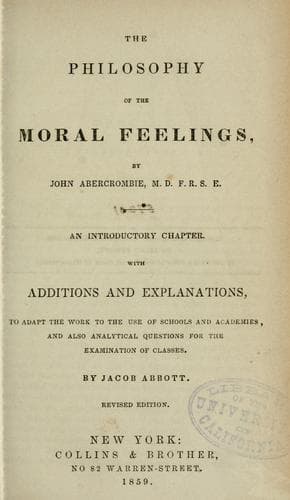
The Philosophy of the Moral FeelingsAbercrombie, John
Religion
The Philosophy of the Moral Feelings
Abercrombie, John
Ethics
peculiar evidence by which is supported the testimony of God.
The truth of these considerations is impressed upon us in the strangest
manner, when we turn our attention to the actual moral condition of
mankind. When we contemplate man, as he is displayed to us by the
soundest inductions of philosophy,--his capacity for distinguishing
truth from falsehood, and evil from good; the feelings and affections
which bind him to his fellow men, and the powers which enable him to
rise to intercourse with God:--when we consider the power, which sits
among his other principles and feelings, as a faithful monitor and
guide, carrying in itself a rule of rectitude without any other
knowledge, and a right to govern without reference to any other
authority; we behold a fabric complete and harmonious in all its parts,
and eminently worthy of its Almighty Maker;--we behold an ample
provision for peace, and order, and harmony, in the whole moral world.
But, when we compare with these inductions the actual state of man, as
displayed to us in the page of history, and in our own daily
observation, the conviction is forced upon us, that some mighty change
has taken place in this beauteous system, some marvellous disruption of
its moral harmony. The manner in which this condition arose,--or the
origin of moral evil under the government of God, is a question entirely
beyond the reach of the human faculties.--It is one of those, however,
on which it is simply our duty to keep in mind, that our business is,
not with the explanation, but with the facts;--for, even by the
conclusions of philosophy, we are compelled to believe, that man has
fallen from his high estate,--and that a pestilence has gone abroad over
the face of the moral creation.
In arriving at this conclusion, it is not with the inductions of moral
science alone, that we compare or contrast the actual state of man. For
one bright example has appeared in our world, in whom was exhibited
human nature in its highest state of order and harmony. In regard to the
mighty purposes which he came to accomplish, indeed, philosophy fails
us, and we are called to submit the inductions of our reason to the
testimony of God. But, when we contemplate his whole character purely as
a matter of historical truth,--the conviction is forced upon us, that
this was the highest state of man;--and the inductions of true science
harmonize with the impression of the Roman Centurion, when, on
witnessing the conclusion of the earthly sufferings of the Messiah, he
exclaimed--"truly this was the Son of God."
* * * * *
Public-domain text, read in full here on John Shaqi.
Reviews
Reviews
No reviews yet
Be the first to share your thoughts on this work.
Elsewhere in the archive
Join the Discussion
Join the discussion
Sign in to leave a comment or review.
Sign InorCreate an account