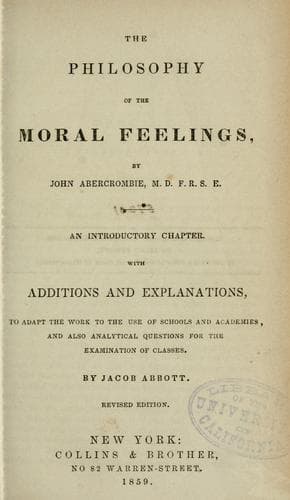
The Philosophy of the Moral FeelingsAbercrombie, John
Religion
The Philosophy of the Moral Feelings
Abercrombie, John
Ethics
When we view such a Being, apart from any inferior creature, all seems
harmony and consistency;--we have only to contemplate him as high and
holy, and enjoying perfect happiness in his own spotless attributes.
But, when we view him in relation to man in a state of moral discipline,
and, in that state, tainted deeply with moral evil, a difficulty arises
of an appalling magnitude. There is ample scope now, we perceive, for
the exercise of his holiness, veracity, and justice; and he appeals in
sublime and terrible majesty, in his exalted character as a moral
governor. But, amid such a display, there is an obvious interruption to
the exercise of compassion,--especially in that essential department of
it,--mercy or forgiveness. This attribute may be exercised without
restraint by an individual, where his own interests alone are concerned,
because in him it involves only a sacrifice of self-love. But
forgiveness in a moral governor either implies an actual change of
purpose, or supposes a former decision to have been made without
sufficient knowledge of, or due attention to, all the facts by which he
ought to have been influenced;--it denotes either undue rigour in the
law, or ignorance or inattention in him who administers it, and it may
very often interfere with the essential requisites of justice. But, in a
moral governor of infinite perfection, there can be neither ignorance of
facts nor change of purpose;--the requirements of his justice must stand
unshaken; and his law, written on the hearts of all his rational
creatures, must be upheld, in the face of the universe, as holy, and
just, and good. Is, then, the exercise of mercy to be excluded from our
conception of the divine character,--and is there no forgiveness with
God.--The soundest inductions of philosophy, applied to the actual state
of man, bring us to this momentous question; but the highest efforts of
human science fail to answer it. It is in this our utmost need, that we
are met by the dictates of revelation, and are called to humble the
pride of our reason before that display of the harmony and integrity of
the divine character. We there learn the truths, far beyond the
inductions of human science, and the utmost conceptions of human
thought,--that an atonement is made, a sacrifice offered;--and that the
exercise of forgiveness is consistent with the perfections of the Deity.
Thus, by a process of the mind itself, which seems to present every
element of fair and logical reasoning, we arrive at a full conviction of
the necessity, and the moral probability, of that truth which forms the
great peculiarity of the Christian revelation. More than any other in
the whole circle of religious belief it rises above the inductions of
science, while reason, in its soundest conclusions, recognises its
probability, and receives its truth; and it stands forth alone, simply
proposed to our belief, and offered to our acceptance, on that high but
Public-domain text, read in full here on John Shaqi.
Reviews
Reviews
No reviews yet
Be the first to share your thoughts on this work.
Elsewhere in the archive
Join the Discussion
Join the discussion
Sign in to leave a comment or review.
Sign InorCreate an account