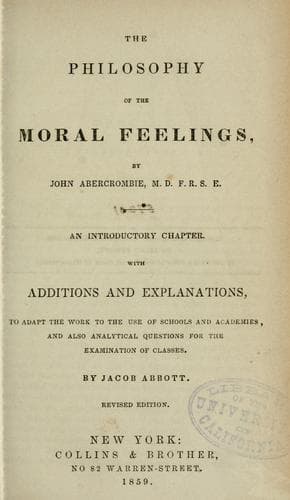
The Philosophy of the Moral FeelingsAbercrombie, John
Religion
The Philosophy of the Moral Feelings
Abercrombie, John
Ethics
In presuming to offer a criticism upon Paley, I readily concede to the
defenders of his system, that it is not to be classed with the
utilitarianism of Hume and Godwin; and that it is not, correctly
speaking, chargeable with selfishness, in holding out the happiness of a
future state as a motive to virtue. The latter part of his system is
clearly countenanced by the sacred writings; and it does appear to be a
stretch of language, to apply the term selfishness to the longing which
the sincere Christian feels for the full enjoyment of God. In regard to
the former part of his doctrine, again, it appears that Paley meant to
propose the will of God as the rule or obligation of morals, and utility
only as a criterion or guide; though it must be confessed that his
language is liable to much misconstruction, and is somewhat at variance
with itself. The real objection to the doctrine of Paley, I apprehend,
lies in his unqualified rejection of the supreme authority of
conscience, and in the mental operation which he substitutes in its
place, namely, a circuitous process of reasoning, in each individual,
respecting the entire and ultimate expediency of actions. There are two
considerations which appear to present serious objections to this part
of the system as a doctrine to be applied to practical purposes. (1.) If
we suppose a man deliberating respecting an action, which he perceives
would be eminently expedient and useful in an individual case, and which
he feels to be highly desirable in its immediate reference to that
case,--we may naturally ask, whether he is in a likely condition to find
his way to a sound conclusion respecting the consequences of the action
"upon the whole, at the long run, in all its consequences, remote and
collateral."--It may certainly be doubted whether, in any case, there
is not great danger of differences of opinion arising, respecting this
extended and ultimate expediency:--and it must be admitted that, in the
man now referred to, the very circumstances of his perception of great
and immediate utility, and the state of desire connected with it, would
constitute a moral condition which might interfere, in a very material
degree, with his calculation as to its ultimate expediency. Upon
whatever system we proceed, I fear it must be conceded as a fact, that
there is a singular propensity in the mass of mankind to consider their
own pains and pleasures before those of other men; and that this
propensity must interfere with the cool course of moral calculation
which the system of utility must consider as indispensable. (2.)
Independently of this consideration, we may be allowed to doubt, whether
any human being can arrive at such an extensive knowledge, as this
theory seems to render necessary, of all the consequences of an action,
remote and collateral. This would appear to constitute a kind and degree
of knowledge to be found only in the Omniscience of the Deity. It is, in
Public-domain text, read in full here on John Shaqi.
Reviews
Reviews
No reviews yet
Be the first to share your thoughts on this work.
Elsewhere in the archive
Join the Discussion
Join the discussion
Sign in to leave a comment or review.
Sign InorCreate an account