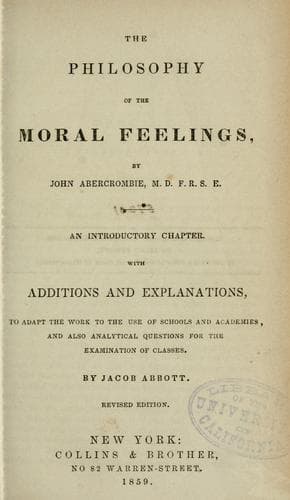
The Philosophy of the Moral FeelingsAbercrombie, John
Religion
The Philosophy of the Moral Feelings
Abercrombie, John
Ethics
fact, by giving its full weight to this difficulty, that the doctrine
of utility has been employed by some foreign writers, in their attempts
to undermine the whole foundation of morals. "The goodness of actions,"
says Beausobre, in his Pyrrhonisme Raisonable, "depends upon their
consequences, which man cannot foresee, nor accurately ascertain." What
harmony, indeed, or what consistency of moral sentiment can we expect
from a system, by which man himself is made the judge of the code of
morals to which he is to be subject, and by which his decisions, on a
question so momentous, are made to lest on those remote consequences of
actions which he must feel to be beyond the reach of his limited
faculties.
If these observations be well-founded, I think we cannot hesitate to
maintain, that, on such a nice calculation of consequences, it is
impossible to found a rule of morals in any degree adapted to the
necessities of man. The same objection applies to every doctrine, which
does not recognise the supreme authority of conscience as an original
part of our moral constitution, warning us of certain conduct as
immutably right, and certain other conduct as immutably wrong, without
any regard either to our own advantage, or to our judgment of the
tendency of the deeds. Whenever we depart from this great principle, we
reduce every moral decision to what must primarily be a process of
reasoning, and in which, from the intricate calculation of consequences
which necessarily arises, there can scarcely fail to be differences of
opinion respecting the tendency of actions, instead of that absolute
conviction which the deep importance of the subject renders
indispensable. It may, farther, be confidently stated, as a matter of
fact, that a conscientious man, in considering an action which involves
a point of moral duty, does not enter upon any such calculation of its
consequences. He simply asks himself,--is it right?--and so decides,
according to an impulse within, which he feels to be a part of his moral
constitution, susceptible of no explanation, and not admitting of being
referred to any other principle. I confess, indeed, that I cannot
perceive, how the doctrine of utility, in any of its forms, can be
reconciled with the principle of moral responsibility. For what we
commonly call vice and virtue, must resolve themselves merely into
differences of opinion respecting what is most expedient in all its
consequences, remote and collateral. We have already alluded to the
considerations which must make this decision one of extreme
difficulty;--and how can we ascribe moral guilt to that, which, though
in vulgar language we may call it vice, must very often be nothing more
than an error in judgment respecting this ultimate good.
Public-domain text, read in full here on John Shaqi.
Reviews
Reviews
No reviews yet
Be the first to share your thoughts on this work.
Elsewhere in the archive
Join the Discussion
Join the discussion
Sign in to leave a comment or review.
Sign InorCreate an account