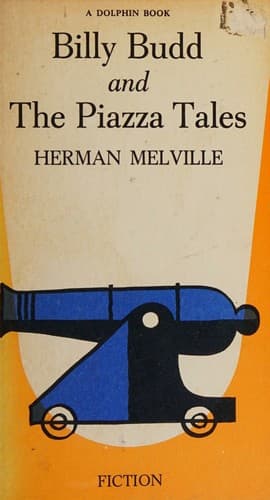
The Piazza Tales
by Herman Melville
Author of “Typee,” “Omoo,” etc., etc., etc.
New York;
Dix & Edwards, 321 Broadway.
London: Sampson Low, Son & Co.
Miller & Holman,
Printers & Stereotypers, N.Y.
1856
Contents
The Piazza
Bartleby
Benito Cereno
The Lightning-Rod Man
The Encantadas
The Bell-Tower
THE PIAZZA.
“With fairest flowers,
Whilst summer lasts, and I live here, Fidele—”
When I removed into the country, it was to occupy an old-fashioned
farm-house, which had no piazza—a deficiency the more regretted,
because not only did I like piazzas, as somehow combining the coziness
of in-doors with the freedom of out-doors, and it is so pleasant to
inspect your thermometer there, but the country round about was such a
picture, that in berry time no boy climbs hill or crosses vale without
coming upon easels planted in every nook, and sun-burnt painters
painting there. A very paradise of painters. The circle of the stars
cut by the circle of the mountains. At least, so looks it from the
house; though, once upon the mountains, no circle of them can you see.
Had the site been chosen five rods off, this charmed ring would not
have been.
The house is old. Seventy years since, from the heart of the Hearth
Stone Hills, they quarried the Kaaba, or Holy Stone, to which, each
Thanksgiving, the social pilgrims used to come. So long ago, that, in
digging for the foundation, the workmen used both spade and axe,
fighting the Troglodytes of those subterranean parts—sturdy roots of a
sturdy wood, encamped upon what is now a long land-slide of sleeping
meadow, sloping away off from my poppy-bed. Of that knit wood, but one
survivor stands—an elm, lonely through steadfastness.
Whoever built the house, he builded better than he knew; or else Orion
in the zenith flashed down his Damocles’ sword to him some starry
night, and said, “Build there.” For how, otherwise, could it have
entered the builder’s mind, that, upon the clearing being made, such a
purple prospect would be his?—nothing less than Greylock, with all his
hills about him, like Charlemagne among his peers.
Now, for a house, so situated in such a country, to have no piazza for
the convenience of those who might desire to feast upon the view, and
take their time and ease about it, seemed as much of an omission as if
a picture-gallery should have no bench; for what but picture-galleries
are the marble halls of these same limestone hills?—galleries hung,
month after month anew, with pictures ever fading into pictures ever
fresh. And beauty is like piety—you cannot run and read it;
tranquillity and constancy, with, now-a-days, an easy chair, are
needed. For though, of old, when reverence was in vogue, and indolence
was not, the devotees of Nature, doubtless, used to stand and
adore—just as, in the cathedrals of those ages, the worshipers of a
higher Power did—yet, in these times of failing faith and feeble knees,
we have the piazza and the pew.
Public-domain text, read in full here on John Shaqi.
Reviews
Reviews
No reviews yet
Be the first to share your thoughts on this work.
Join the Discussion
Join the discussion
Sign in to leave a comment or review.
Sign InorCreate an account