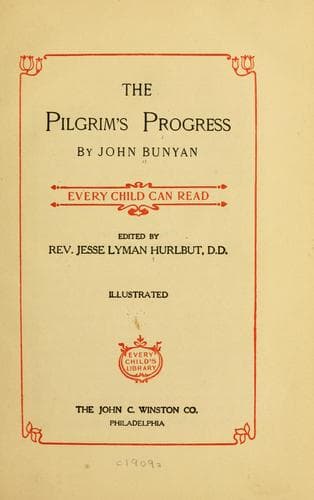
The Pilgrim's Progress by John Bunyan Every Child Can ReadBunyan, John
Religion
The Pilgrim's Progress by John Bunyan Every Child Can Read
Bunyan, John
Christian life -- Juvenile literature; Christian pilgrims and pilgrimages -- Juvenile literature
Perhaps a short account of Bunyan's own life may add to the interest of
his book. John Bunyan was born in 1628 at Elstow, a small village near
Bedford, which is in the heart of England. His father was a poor man,
traveling on foot from place to place mending pots and pans and the
simple furniture of country kitchens, and the son followed the same
trade, and was known as a "tinker." He tells us that he lived a wild
life, and was especially known as one of the worst swearers in the
region.
When the great Civil War broke out in England, in 1642, between King
Charles the First and the Parliament, Bunyan became a soldier on the
side of the Commonwealth, as the party against the king was called. He
served in the army between 1644 and 1646.
In 1648, at the age of twenty years, he married a good young woman, who
led him to prayer and to a new life. But it was hard for one who had led
such a life as his had been to turn to God, and it cost the young man a
great struggle. It seemed to him that his past sins were like a load
upon his back, just as he afterward wrote of his "pilgrim," and it was
long before he found peace.
He became a member of a little Baptist society, and soon began to
preach. Crowds came to hear him, drawn by his earnest spirit and his
quaint striking manner. But when Charles the Second became king, no
religious services were allowed except those of the Church of England,
and all other meetings were forbidden. Bunyan however went on preaching,
until he was sent to prison in Bedford. In Bedford jail he stayed twelve
years. To find a means of living in jail, he made lace, and sold it as a
support for himself and his blind daughter.
If the prison was hard for Bunyan his sufferings were made a blessing to
untold millions, for while in Bedford jail he wrote the Pilgrim's
Progress. This story was intended to be a parable, like many of our
Saviour's teachings; that is, it put into the form of a story the life
of one who turns from sin, finds salvation through Christ, and in the
face of many difficulties makes his way through this world to heaven.
Even a child who reads or listens to the book will see this meaning in
part; and he will understand it better as he grows older.
In 1672 Bunyan was set free, and allowed to begin again his work as a
Baptist minister, and he soon became one of the most popular preachers
in all England. He died quite suddenly in 1688, when he was sixty years
old, and is buried in an old graveyard now near the center of London,
called Bunhill Fields Burial-ground. In the same ground is buried
another great writer, Daniel DeFoe, whose story of "Robinson Crusoe"
ranks next to the Pilgrim's Progress in the number of its readers; also
Isaac Watts, the author of many hymns sung in all the churches, and Mrs.
Susanna Wesley, the mother of the great John Wesley. Four people who
have left a deep mark upon the world, all lie near together in this
small cemetery in London.
Public-domain text, read in full here on John Shaqi.
Reviews
Reviews
No reviews yet
Be the first to share your thoughts on this work.
Join the Discussion
Join the discussion
Sign in to leave a comment or review.
Sign InorCreate an account